
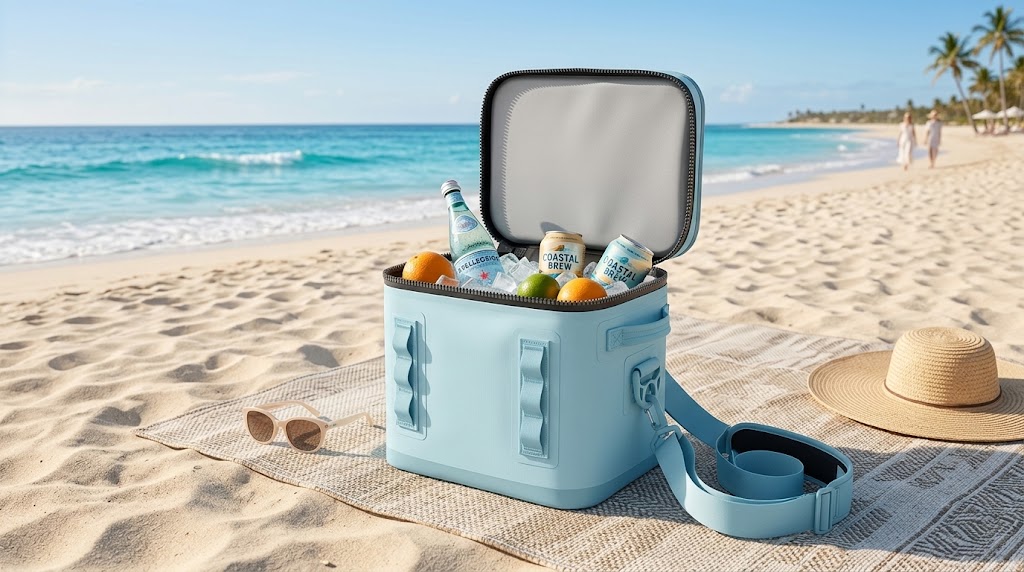
A leakproof cooler bag can mean two very different products, and most listings don’t say which one you’re getting. One is a standard soft cooler with a stitched fabric shell and a PEVA liner. Melted ice stays inside as long as the bag stands upright, but tip it over in a car boot and water finds the seams and the zipper. The other is a welded TPU soft cooler with an airtight zipper. You can fill it with water, close it and turn it upside down. Both are useful. They just suit different customers, different price points and different claims on your product page.
This guide is about the second kind: TPU tote, handheld and car coolers, the line we make most of in this category, usually in the 14–25L range (roughly 8 to 36 cans). It covers how they’re built, why the zipper decides more than the fabric, what to test on a sample, and what drives MOQ and price. For the broader picture of cooler bag MOQ tiers, linings and OEM/ODM options, start with our Custom Cooler Bags: The Complete B2B Manufacturing Guide.
Who Buys TPU Leakproof Cooler Bags?
This isn’t the lunch-bag or promotional end of the market. The buyers who come to us for welded TPU coolers mostly fall into three groups:
Outdoor, fishing and boating brands. Their customers put the cooler on a boat deck, in the bed of a truck or on wet sand, and they use it for fish and bait as well as drinks. Leaks here aren’t an inconvenience, they’re a smell in the car for a week. These buyers care about puncture resistance, a base that survives being dragged, and lash points or a shoulder strap that can take a full load.
Amazon, eBay and DTC sellers in the heavy-duty soft cooler niche. This is a crowded category where the listing is built around a few hard claims: leakproof, waterproof, ice for X days, Y cans. Those sellers need a product that actually backs those claims up, because reviews in this niche are written by people who test them.
Camping, beach and road-trip brands. A car cooler that can lie on its side in a packed boot without leaking is the selling point. Tote and handheld shapes do well here because they fit between seats and are easy to carry from car to beach.
Leakproof, Waterproof and Airtight Aren’t the Same Claim
It helps to separate three things that often get blended together on product pages:
- Leakproof is about water getting out: melted ice, spilled drinks, fish slime. A truly leakproof cooler holds liquid even when it’s tipped over or upside down.
- Waterproof is about water getting in: rain, spray, a wave over the side of a boat. A cooler can shed rain well and still leak melt water through its base seams when it’s knocked over.
- Airtight is about the closure. An airtight zipper blocks both water and air, which also helps ice last because warm air isn’t swapping in and out.
A stitched cooler with a good PEVA liner is usually leak-resistant: fine standing upright, not something to promise for a bag lying on its side. A welded TPU cooler with an airtight zipper can honestly claim all three. If you sell the first kind, describe it as leak-resistant. “Leakproof” invites the one test it will fail.
How a Welded TPU Cooler Is Built (and Why Stitching Can’t Match It)
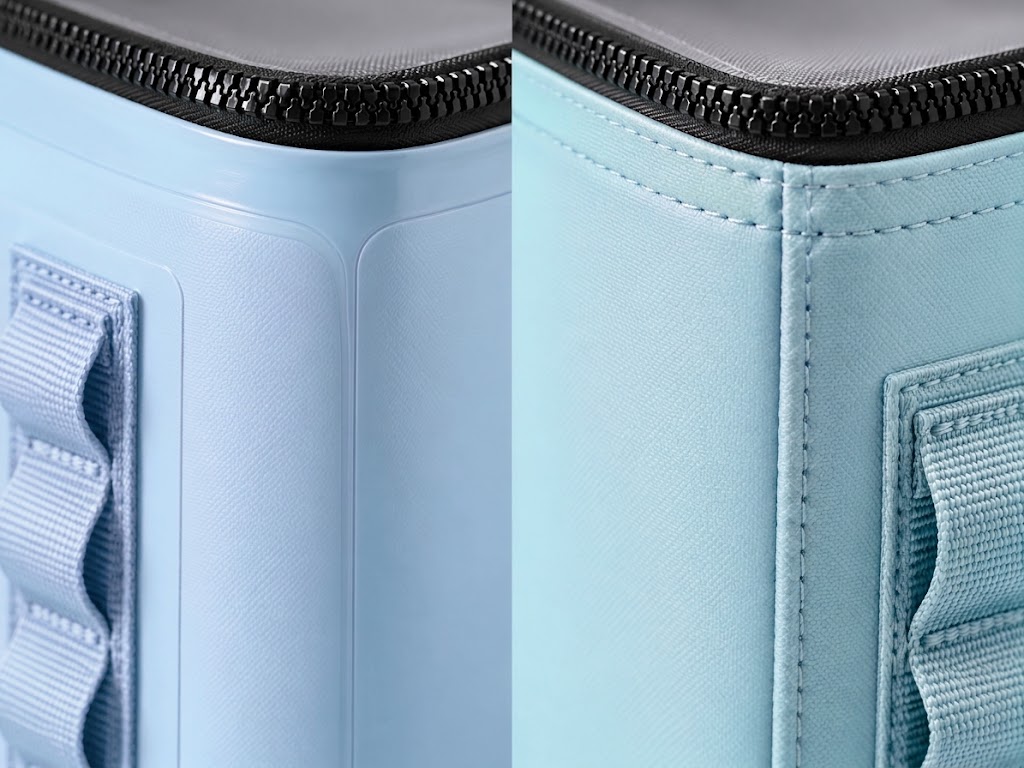
Stitched construction. A conventional soft cooler has a fabric outer (Oxford or polyester), a foam insulation layer and a PEVA or similar liner. Wherever panels are sewn, the needle leaves a line of tiny holes, and water that reaches a seam line can work its way through (Advnture). The liner does most of the work keeping melt water in, which is why it holds up upright and struggles when the bag is tipped.
Welded TPU construction. Instead of sewing, TPU-laminated panels are joined with heat, typically high-frequency (RF) welding, which uses an electromagnetic field to heat and fuse the material. RF welding produces a much more consistent, airtight seam than sewing and can create hermetic seals, and TPU is one of the materials it’s used on (UFP MedTech). With no needle holes and no thread to wick water, the shell itself becomes the barrier. The inner liner is welded the same way, and the insulation sits sealed between the two.
Insulation. Heavy-duty soft coolers generally use closed-cell foam, which doesn’t absorb water and blocks airflow. That matters in a leakproof design, because open foam that soaks up condensation becomes heavy and smells.
A practical consequence for your design brief: welding favors simple, clean shapes. Box-like totes and handheld coolers weld well. Lots of small external pockets, complex curves and sewn-on accessories each need to be attached without punching holes in a sealed shell, and every attachment point is a place a leak can start. Our Cooler Pillar covers a real example of this: a customer’s drain valve request that meant rethinking the lining so the “convenience” feature didn’t become the leak.
Why TPU rather than PVC?
PVC-coated fabrics can be welded too, and they’re cheaper. TPU tends to win for coolers that touch drinks and food and get flexed constantly: it contains no plasticizers, while many PVC-coated fabrics rely on them, and plasticizers can migrate to the surface and attract dirt (Specialty Fabrics Review). TPU is also generally more flexible and abrasion-resistant than PVC, which shows on a soft cooler that gets squeezed into car boots and dragged across decks. Shell fabrics are usually specified by the denier of the base fabric under the TPU (600D and 840D are common), and heavier bases resist punctures better at the cost of weight.
The Zipper Decides More Than the Fabric
You can weld every seam perfectly and still sell a leaking cooler if the zipper isn’t up to it. The opening is the longest unsealed line on the bag, so it’s where the real choice gets made.
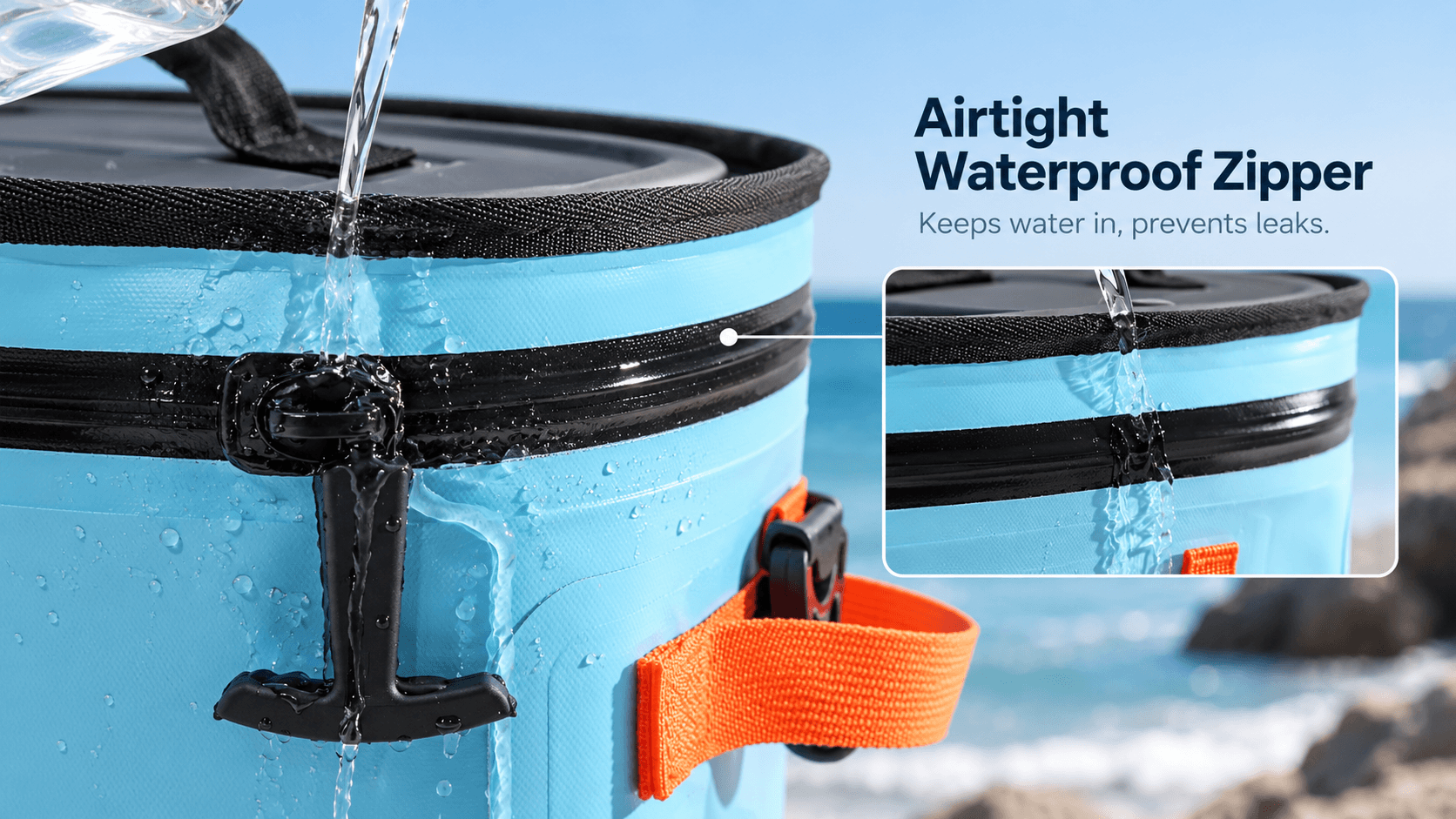
Airtight zippers. These use a sealing lip that’s pressed together as the zipper closes, and the slider has to park fully in its end “port” for the seal to be tight. Ortlieb, which makes the TIZIP zipper, notes that sealing zippers are harder to move than normal ones, need lubricating at regular intervals, and lose tightness if dirt gets between the teeth (Ortlieb). Soft cooler brands give the same advice: lubricate the zipper regularly, especially after salt water, and always zip it fully closed (RTIC).
That stiffness is the most common complaint in reviews of heavy-duty soft coolers, and it’s worth planning for rather than hoping customers won’t notice:
- Put a small tube of zipper lubricant in the box, or at least a care card telling the customer to lubricate and to close the slider fully.
- Say it on the listing. “The airtight zipper is stiff by design” turns a one-star complaint into an expectation.
- Specify a large, easy-to-grip pull. It makes a stiff zipper much easier to live with.
Water-resistant zipper plus a storm flap. Cheaper and much easier to open, and fine for a cooler that mostly stands upright. But it isn’t airtight, and it won’t hold liquid when the bag is tipped. If your product page says leakproof, this isn’t the zipper for it.
How to Check a Sample Before You Approve It
We leak-test cooler bags as a standard step before every shipment, but you should still check the sample yourself. A simple version takes a few minutes:
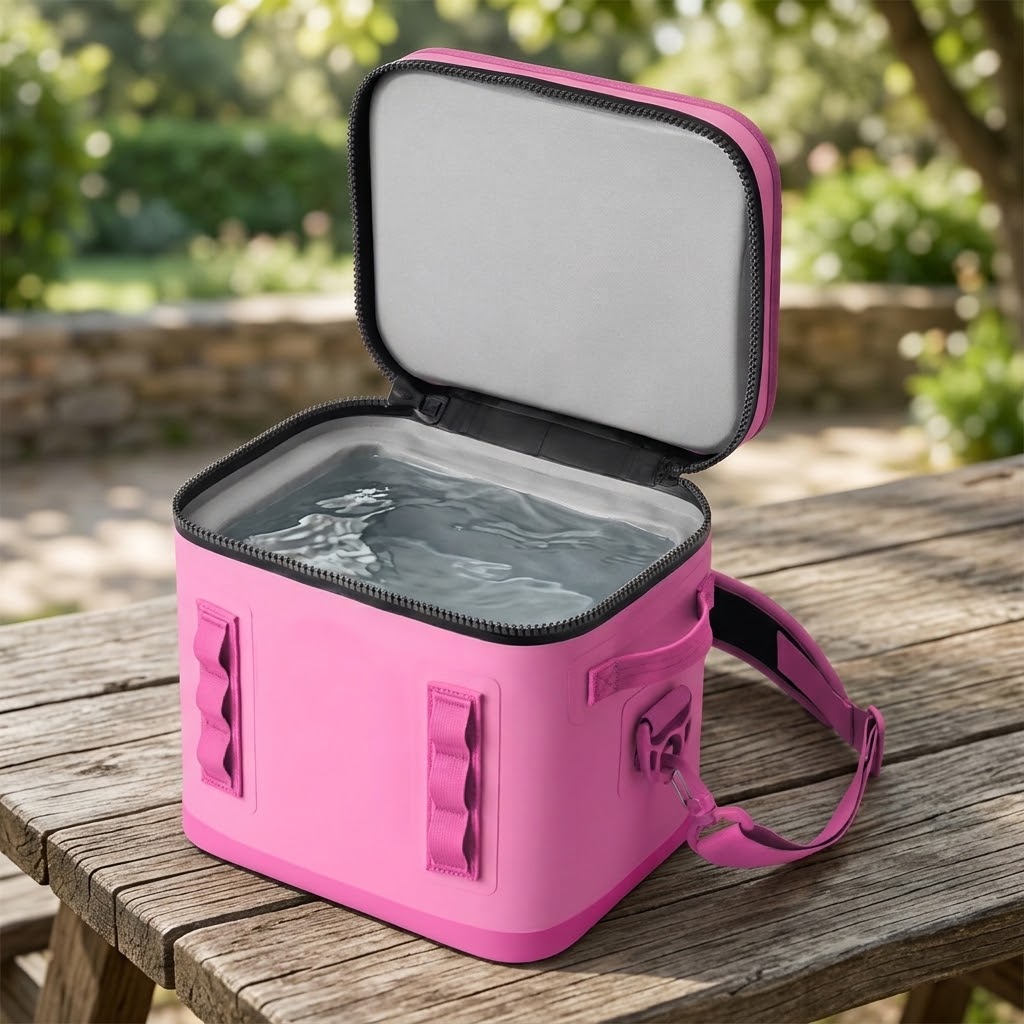
- Fill it partly with water, zip it fully closed, and make sure the slider is seated in its end port.
- Turn it on its side, then upside down over a sink or a tray, and leave it for a while.
- Check the seams, the zipper ends and every attachment point: handles, D-rings, strap anchors, any logo patch. Those are where small leaks show first.
- Open and close the zipper ten or twenty times. If it’s already a fight on a new sample, your customers will feel it more after a summer of sand and salt.
If you plan to advertise ice retention, test that too, and write down the conditions (how much ice, starting temperature, outside temperature, how often the bag was opened). Brand claims in this category are usually stated “up to” a number of days, and the result depends heavily on those conditions. Our guide on how long cooler bags keep food cold explains what drives the difference.
Branding a TPU Cooler
The rule of thumb is simple: don’t stitch anything through a welded shell. A sewn-on label puts needle holes straight into the panel you paid to make leakproof. Logos on TPU coolers are usually printed, or applied as a patch that’s welded or bonded on rather than sewn. Print adhesion varies with the TPU surface finish (matte or gloss), so ask to see your actual logo on the actual shell material at the sample stage, and rub-test it. For how the main printing methods compare, see our bag branding techniques guide.
MOQ & Pricing
- In-stock styles: from 50 pieces. An existing TPU tote, handheld or car cooler in our standard colors. A heat-transfer logo can be added from 100 pieces.
- Custom designs: from 500 pieces. New shapes, custom colors, your own zipper spec, added pockets or accessories. Welded products need shape-specific setup, and below about 500 units that setup doesn’t spread far enough.
Price is driven less by capacity than by these choices:
- Shell fabric weight (for example 600D versus 840D under the TPU)
- Zipper type: airtight versus water-resistant with a flap
- Insulation thickness, which also changes the outer size for the same inner capacity
- Accessories: shoulder straps, lash points, bottle openers, drain valves, each adding parts and welding steps
As a rough guide, welded TPU coolers start at around $15 per unit for small, simple designs and commonly run $30–60 or more for larger capacities, heavier shells and fully featured specs. Very large or heavily accessorized coolers can go higher still. A stitched or PVC cooler of similar size usually comes in well under that, often around $7–12. The gap is the airtight zipper and the welding process, not just the fabric. Send us your target capacity, shape and zipper preference and we’ll quote both options side by side if you’re undecided.
What to Have Ready Before You Request a Quote
- Shape: tote, handheld box, or car cooler, plus a reference photo if you have one
- Capacity, in liters or cans
- The claim you want to make: fully leakproof (welded TPU plus airtight zipper) or leak-resistant (lower cost)
- Zipper preference, if you already have one
- Shell weight and color
- Accessories: shoulder strap, lash points, bottle opener, drain valve
- Logo method and placement
- Rough quantity: in-stock (50+) or custom (500+)
FAQ
How much does a leakproof TPU cooler bag cost?
Roughly $15 per unit at the small, simple end, and $30–60 or more for larger, heavier-duty or fully featured designs. Shell weight, zipper type, insulation and accessories move the price more than capacity alone.
Is a TPU cooler bag really leakproof? A TPU cooler with welded seams, a welded liner and an airtight zipper can hold liquid even upside down. A TPU-look cooler with sewn seams or a standard zipper can’t. Ask how the seams are joined and what zipper is used, not just what the fabric is.
What’s the difference between a leakproof and a waterproof cooler bag? Leakproof keeps melt water and spills inside, even when the bag is tipped. Waterproof keeps rain and spray out. A welded TPU cooler with an airtight zipper does both, while a stitched cooler usually only handles light rain and stays leak-resistant when upright.
Why is the zipper on a leakproof cooler so stiff? Airtight zippers use a sealing lip that’s pressed shut, so they’re harder to pull than normal zippers. Regular lubrication and closing the slider fully into its end port keep them working properly.
What’s the minimum order for a custom leakproof cooler bag? 50 pieces for in-stock styles (from 100 with a heat-transfer logo), and 500 pieces for custom designs.
Can I add pockets or a drain valve to a welded cooler? Yes, but each addition is another attachment point on a sealed shell, so it has to be designed in from the start rather than added late. It also adds cost and testing.
Whether you’re building a fishing-and-boat cooler, a heavy-duty soft cooler for Amazon or a road-trip tote, we can help you decide where a welded, airtight build earns its cost and where a leak-resistant design is enough. Get in touch with your capacity, shape and quantity, or browse our cooler bag range.
Explore Our Leakproof Cooler Range
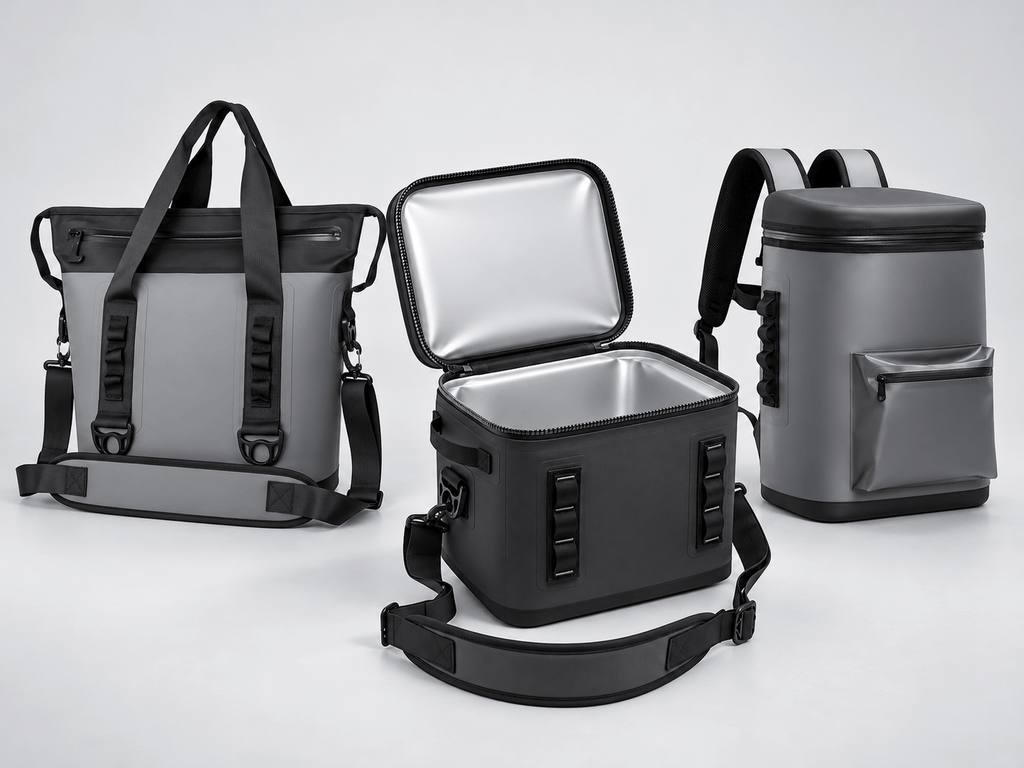
We offer a full range of welded TPU leakproof coolers, including totes, handheld coolers and backpacks in multiple sizes. Colors, capacity, accessories and logo can all be customized. Many styles are new and not yet listed on our website, so contact us for the full catalog, samples and pricing.