
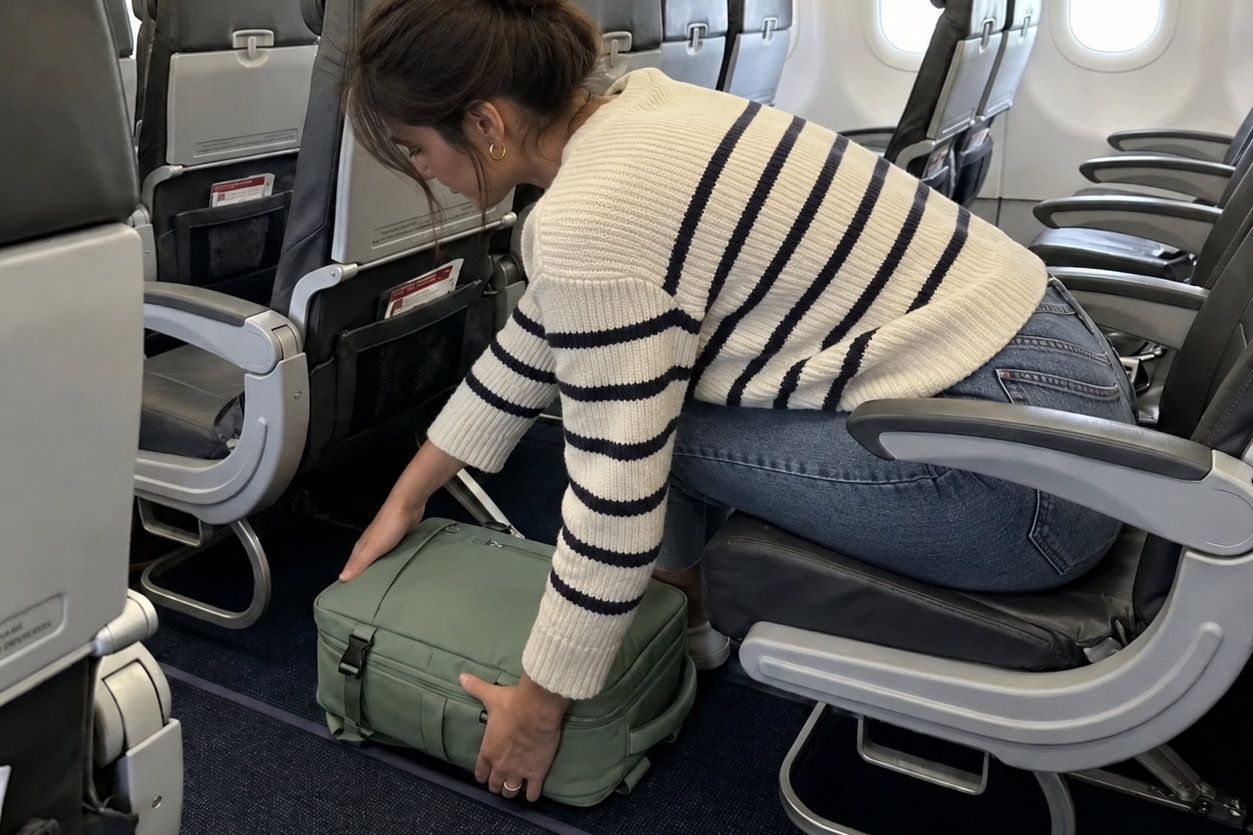
A 40x30x20 cabin backpack is a bag built to fit the free under-seat allowance on Ryanair and Wizz Air: 40 cm high, 30 cm wide and 20 cm deep, roughly 24 litres. If you sell to UK or European travellers, this is now one of the most searched-for bag sizes, and that’s mainly down to one change: in September 2025 Ryanair enlarged its free small bag from 40x25x20 cm to 40x30x20 cm.
For an Amazon seller or a travel brand, the hard part isn’t finding a bag labelled “40x30x20”. It’s finding one that still fits the airport sizer when it’s packed full. This guide covers which airlines actually use this size, what size tolerance to expect from a soft, hand-sewn bag, which design features keep a full bag within the limit, and what to specify when you order from a factory.
Which Airlines Use the 40x30x20 Size?
40x30x20 is a budget-airline size. Full-service European carriers mostly use a slimmer 15 cm depth, and easyJet allows something larger. Here’s how the main free under-seat allowances compare:
| Airline | Free under-seat item | Notes |
|---|---|---|
| Ryanair | 40 x 30 x 20 cm | Enlarged from 40 x 25 x 20 cm in September 2025 |
| Wizz Air | 40 x 30 x 20 cm | Max 10 kg |
| easyJet | 45 x 36 x 20 cm | Max 15 kg, including wheels and handles |
| Vueling | 40 x 20 x 30 cm | |
| Air France, KLM, British Airways, Iberia | 40 x 30 x 15 cm | Same footprint, 5 cm shallower |
| Lufthansa, Swiss, Austrian | 40 x 30 x 10 cm |
Sources: TravelExtra’s airline-by-airline comparison and airline announcements. Airline rules change often, so check the airline’s own page before finalising your product listing.
There’s also a longer-term change coming. The EU has agreed a standard free personal item of 40 x 30 x 15 cm for all EU flights, but it isn’t expected to apply before 2027. Until then, each airline keeps its own rules.
What this means for your range: a 40x30x20 bag is the right fit if your customers mostly fly Ryanair or Wizz Air. If you also want to cover the 15 cm carriers, you’ll need either a slimmer version or a design whose depth compresses. Many sellers end up stocking two or three sizes rather than one “universal” bag.
One Product Line, Three Common Cabin Sizes
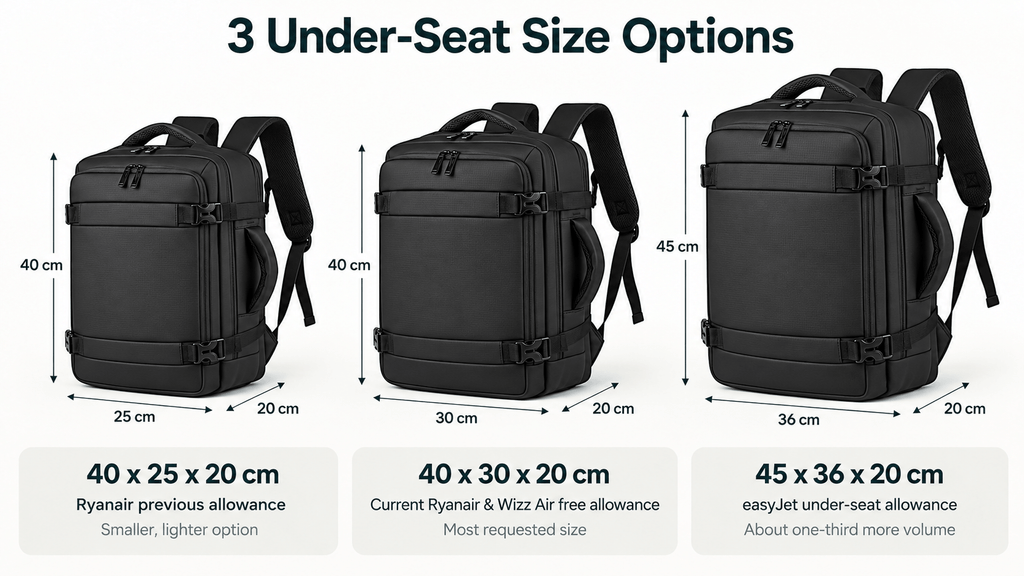
Nice Bags produces cabin backpacks in the three sizes UK and EU buyers ask for most:
- 40 x 30 x 20 cm: the current Ryanair and Wizz Air free allowance, and the size most buyers ask for.
- 40 x 25 x 20 cm: Ryanair’s previous allowance. It still sells, because a smaller bag passes on almost every airline, and some travellers prefer it.
- 45 x 36 x 20 cm: easyJet’s under-seat allowance, which gives roughly a third more volume.
If you’re building an Amazon listing family, selling these as size variants of one design (same fabric, same logo, same colourways) is usually simpler than launching three unrelated products. It also keeps your reviews in one place.
Size Tolerance: What to Expect from a Soft, Hand-Sewn Bag
Buyers coming from hard-shell luggage sometimes expect a cabin backpack to measure exactly 40.0 x 30.0 x 20.0 cm. A soft backpack doesn’t work that way, and understanding why helps you set the right expectations with your customers.
How the pattern is built. We cut the pattern from the base panel, so the bag’s footprint is set to the specified dimensions from the start. Everything above the base is soft fabric, padding and hand-sewn seams. Fabric thickness, padding and seam allowances all affect the finished shape, so a soft bag will never be as exact as a moulded case. Within about 2 cm of the specified size is normal for this kind of construction, and a first sample can come out 1–2 cm over on one dimension without anything having gone wrong.
Why it still passes the sizer, even fully packed. Airlines measure the outside of the bag, including any handles or wheels. With a hard case, 1 cm over means the bag doesn’t go in. A well-designed soft cabin backpack works differently, and two design choices do most of the work:
- A boxy, structured shape. Squared-off panels and padded sides hold the bag’s rectangular profile when it’s full, instead of letting it round out like a sack. The bag stays close to its specified dimensions whether it’s half-empty or packed to the top.
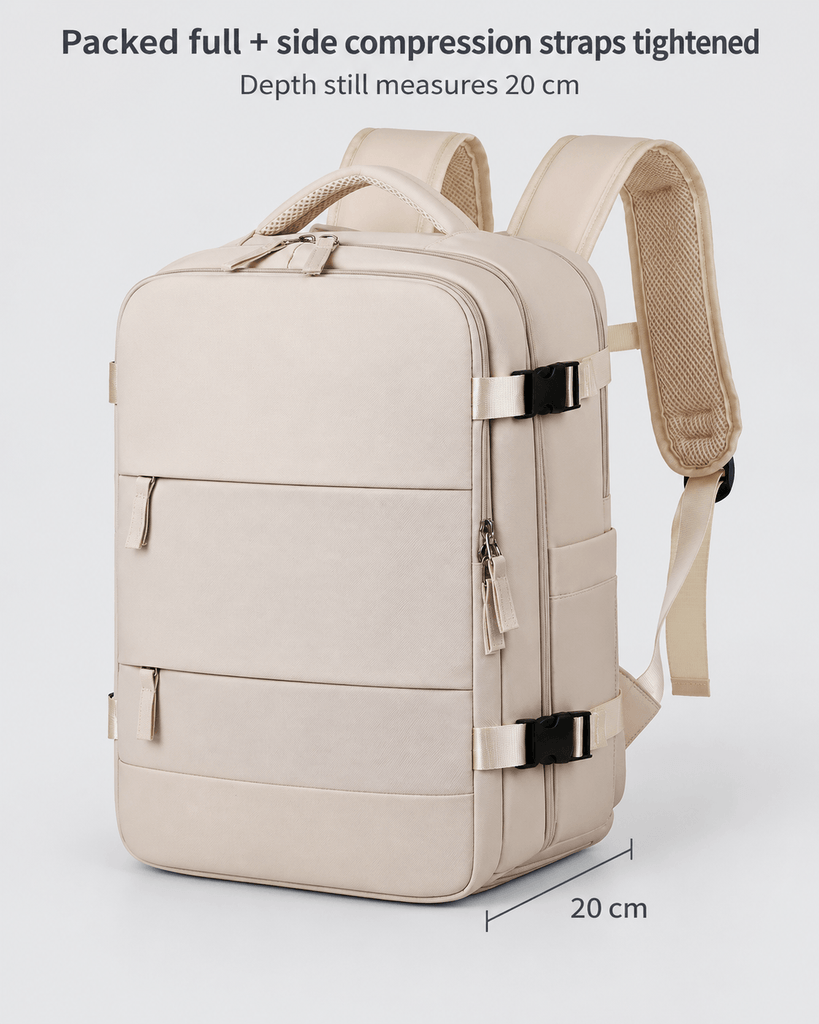
- Side compression straps. Once the bag is packed, the traveller cinches the side straps and pulls the panels back in. The depth stays within the 20 cm limit, and the bag slides into the frame or under the seat without a struggle.
So a properly designed 40x30x20 backpack can be packed full and still board as a free under-seat item. The bag only goes out of shape if a traveller forces in far more than it was designed to hold.
How the bag is measured. There’s no single industry method for measuring soft bags. China’s national standard for backpacks and handbags, QB/T 1333-2018, dropped its size requirement in the 2018 revision. QC inspectors measure with a tape measure, but the method varies: some measure from side seam to side seam, others at the widest point including pockets. Two inspectors can therefore record different numbers for the same bag. Before production, we agree the measuring method with the buyer and brief our QC team to measure exactly the way the buyer’s inspector will. That way, the numbers on our QC report and on your inspection report match.
For your listing: show the compression straps in action. A photo or short video of the bag packed full with the straps cinched, sitting in a 40x30x20 frame, answers the “will it fit?” question before customers ask it.
What Buyers Usually Specify on a 40x30x20 Cabin Backpack
Inside a fixed 24-litre box, every feature takes space from something else. These are the trade-offs that come up most in sampling.
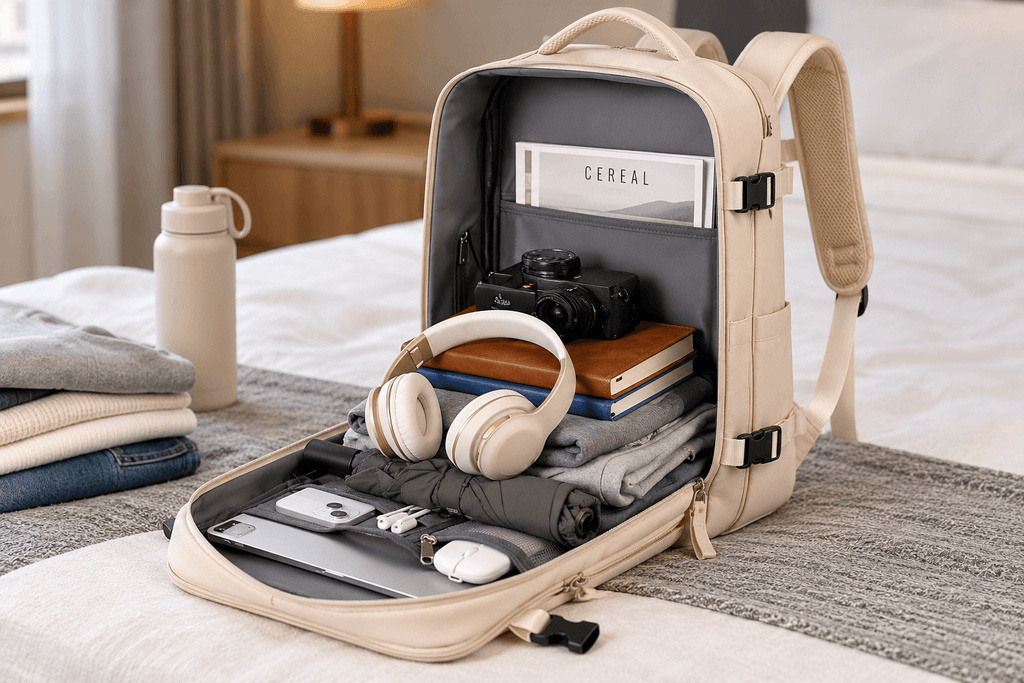
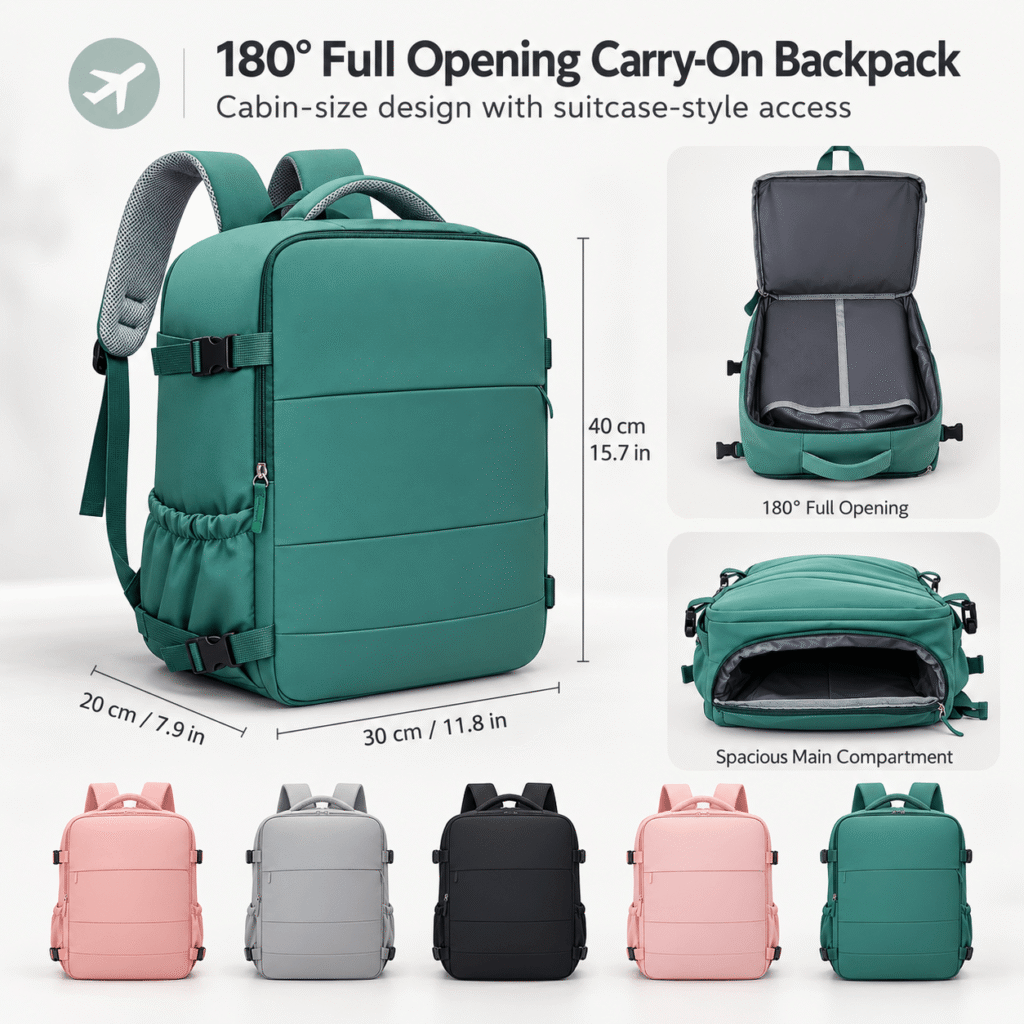
Clamshell (suitcase-style) opening vs. top-loading. A zip that opens the main compartment fully, like a suitcase, is the most requested layout for travel use, because it lets travellers pack it like a mini carry-on. Top-loading designs are simpler and cheaper but harder to pack flat.
Trolley sleeve. A back-panel strap that slides over a suitcase handle is a small, low-cost feature that buyers consistently ask for. It matters most for travellers who also bring a paid cabin bag or a checked suitcase.
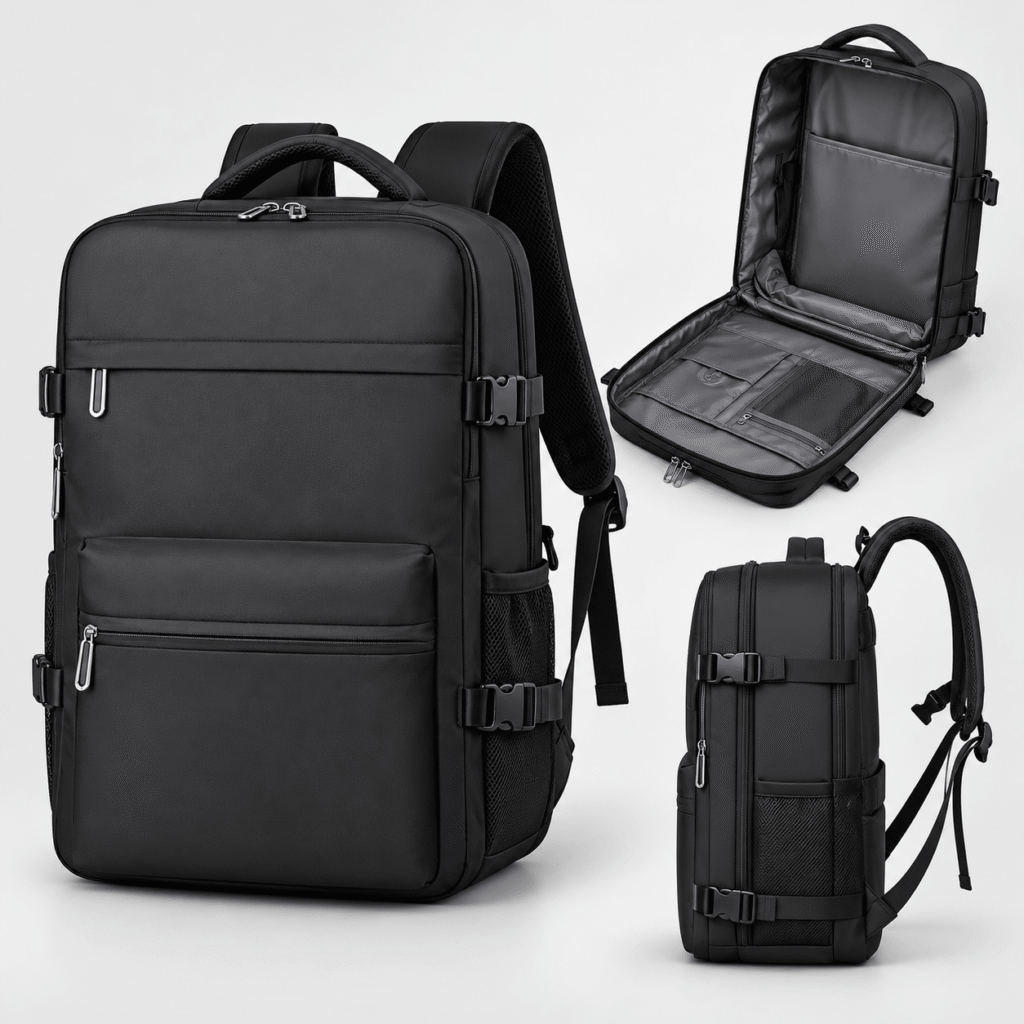
Laptop compartment. Most of our 40x30x20 styles fit a 15.6-inch laptop in a padded back-panel sleeve, which is what business and student travellers usually expect. The exact fit depends on the style, so check it model by model. The sleeve does take depth from the main compartment. Ask the factory for the internal sleeve dimensions, not just the screen size, because laptops with the same screen size vary in footprint.
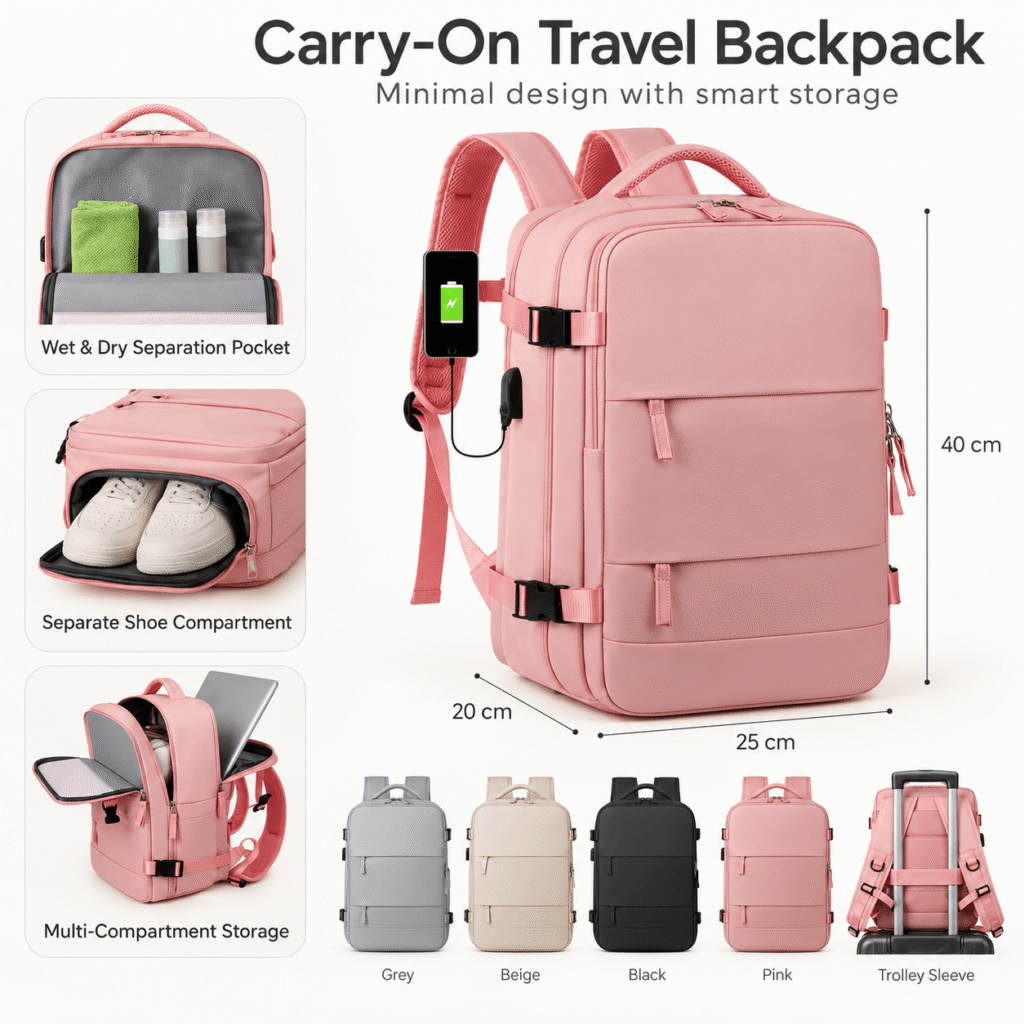
Wet/dry separation and shoe compartments. A separate zipped section at the bottom for shoes or damp clothes is one of the most common features in this category. It’s useful, but it divides an already small bag, so it suits travellers on short trips rather than people trying to fit a week’s packing into 24 litres.
Internal vs. external bottle pockets. Side mesh pockets are popular, but an external pocket with a full bottle adds width. On a bag that’s already at the 30 cm limit, an internal bottle sleeve is the safer choice.
Compression straps. Side straps are what keep a fully packed bag within the 20 cm depth, so on a cabin backpack they’re a core feature, not decoration. When the bag is only part-full, they also cinch it slimmer, which helps on tighter seats.
Lightweight fabric. Wizz Air caps the free bag at 10 kg, and travellers notice when the bag itself is heavy. Across our 40x30x20 range, empty weights run from about 0.4 kg for a stripped-back Oxford pack to around 0.9 kg for styles with a padded laptop sleeve, shoe compartment and USB port. Every feature you add costs grams as well as money. For a full comparison, see our backpack material guide.
Who Buys 40x30x20 Cabin Backpacks in Bulk?
Most of the enquiries we receive for this size come from two types of buyer:
- UK and European Amazon sellers. This size is a high-volume category on Amazon UK and the EU marketplaces. These sellers usually want to test the market quickly, so they start with in-stock styles and add their own branding or packaging.
- Travel brands. Brands selling luggage or travel accessories that want to add an under-seat backpack to their range, often in matching colours or materials.
For both types, the main question is speed versus control: how quickly the product can go live, and how much of the design they need to own.
MOQ: In-Stock Wholesale vs. Custom Production
Most buyers in this category start with in-stock wholesale, which has two practical advantages: low quantities and a short lead time.
| In-stock wholesale | Custom / OEM-ODM | |
|---|---|---|
| MOQ | From 50 pcs | From 500 pcs |
| What you get | Existing designs in the size you need | New design, size, structure or fabric |
| Best for | Testing a listing, filling a gap in your range | Building a product only you sell |
The 500-piece threshold for custom work reflects the cost of making a new pattern, sampling and sourcing materials. Below that quantity, the setup costs are spread across too few units. For more on how MOQ works across different levels of customisation, see our guide to low MOQ backpack manufacturing.
Branding on in-stock styles: you don’t need to go custom to put your brand on the bag. In-stock 40x30x20 backpacks can take a heat-transfer logo from 50 pieces. For many Amazon sellers this is the fastest route to a branded listing. To compare logo methods, see our bag branding techniques guide.
How Much Does a 40x30x20 Cabin Backpack Cost?
As a rough guide for wholesale quantities, ex-factory and before shipping:
| Tier | What it looks like | Indicative price per unit |
|---|---|---|
| Basic in-stock | Lightweight Oxford, simple compartments, trolley sleeve | About $5–8 |
| Feature-rich in-stock | Padded laptop sleeve, shoe/wet compartment, USB port, expandable zip | About $8–15 |
| Custom | Your own pattern, fabric, colour or structure, from 500 pcs | Usually $8–20+, depending on spec |
These ranges are deliberately wide. Final pricing depends on fabric, quantity, branding and packaging, so treat them as a starting point for budgeting rather than a quote.
Price is mostly driven by structure, not size. A simple top-loading pack and a clamshell bag with a padded laptop sleeve and trolley strap can share the same 40x30x20 footprint and still differ significantly in cost. For a breakdown of what drives backpack pricing, see how much a custom backpack costs.
Questions to Ask Before You Order
- How will the bag be measured? Seam to seam or at the widest point, and does it include handles, feet and front pockets? Agree this before production so your inspector and the factory’s QC measure the same way.
- What size variation should you expect? For soft, hand-sewn backpacks, within about 2 cm of the spec is normal. Ask to see a sample before bulk production.
- What are the internal dimensions of the laptop sleeve, if there is one?
- What does the empty bag weigh?
- Can the same design be made in 40x25x20 and 45x36x20 so you can sell size variants?
- What’s in stock right now, and how quickly can 50–200 pieces ship?
FAQ
Is 40x30x20 the same as Ryanair’s free bag size? Yes. Since September 2025, Ryanair’s free small bag allowance has been 40 x 30 x 20 cm. Before that it was 40 x 25 x 20 cm. Wizz Air also uses 40 x 30 x 20 cm for its free personal item.
Will a 40x30x20 backpack fit on British Airways or KLM? Not as a free personal item, if it’s packed to the full depth. British Airways, KLM, Air France and Iberia allow 40 x 30 x 15 cm under the seat, which is 5 cm shallower. A soft backpack that isn’t fully packed may compress to fit, but you shouldn’t promise that in a listing.
How many litres is a 40x30x20 backpack? About 24 litres if you multiply the outside dimensions. Usable volume is lower, because fabric, padding and pockets take up space.
What’s the minimum order for 40x30x20 cabin backpacks? At Nice Bags, in-stock styles start from 50 pieces, and custom designs start from 500 pieces.
Can I add my logo to in-stock 40x30x20 backpacks? Yes. In-stock styles can take a heat-transfer logo from 50 pieces, so you can launch a branded product without a full custom order.
Will a 15.6-inch laptop fit in a 40x30x20 backpack? Most of our 40x30x20 styles fit a 15.6-inch laptop, but it depends on the style. Ask for the internal sleeve dimensions of the model you’re considering and check them against the laptop itself, because laptops with the same screen size can differ by a centimetre or more.
Can you make the easyJet size too? Yes. We produce cabin backpacks in 40x30x20, 40x25x20 and 45x36x20 cm, so you can cover Ryanair, Wizz Air and easyJet travellers in one range.
Explore Our 40x30x20 Cabin Backpacks
These three styles are joining our range shortly. In-stock quantities start from 50 pieces, and you can add a heat-transfer logo from 50 pieces too. Send us an enquiry now for photos, colour options and lead times.
1. Lightweight 180° Clamshell Cabin Backpack (40x30x20 cm) Opens flat like a suitcase and weighs about 0.4 kg empty. Built for travellers who want every gram of the Wizz Air and Ryanair allowance for their own things.
2. Expandable 24L Under-Seat Business Backpack (40x30x20 cm) A clean, minimalist black design with a padded laptop sleeve and an expansion zip for the return trip. Suits business travellers and commuters.
3. Travel Backpack with Shoe Compartment & USB Port (40x30x20 / 40x25x20 cm) Wet/dry separation at the base and a USB charging port. Comes in both the current and the previous Ryanair size, so you can list both as size variants.
[ Enquire About These Styles → ]
Browse the full range in our 40x30x20 Cabin Backpacks collection, or contact us with your target size, quantity and features. We’ll tell you what’s in stock and what needs a sample.
For a broader view of sourcing backpacks for your brand, start with our B2B backpack sourcing guide. If your customers travel for work and need a full-size carry-on backpack rather than an under-seat bag, see how to choose a business travel backpack.