
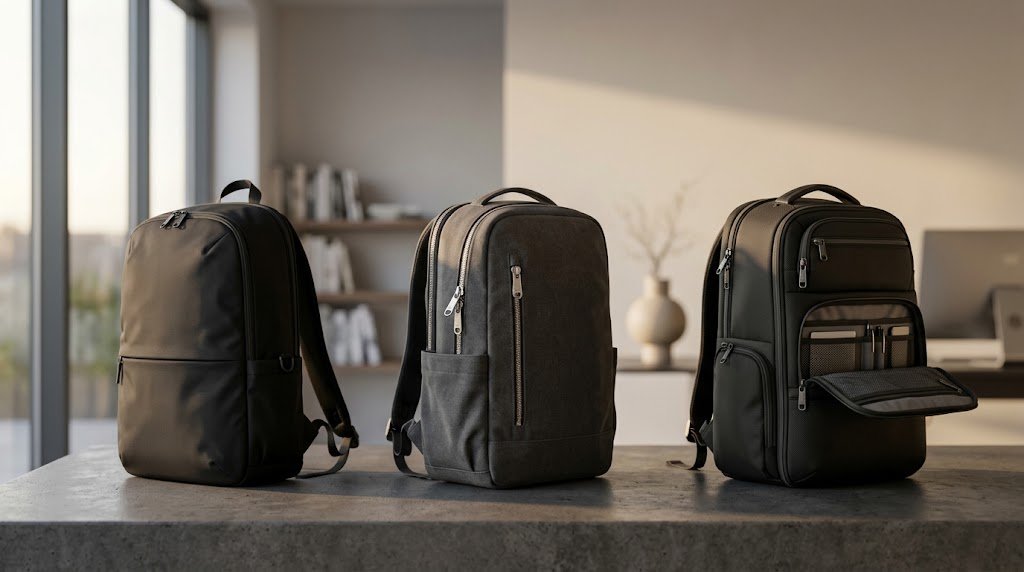
Quick answer: Custom business backpack cost for a decent-quality, standard configuration typically runs $5-8 per unit at factory price. But that number moves a lot depending on what’s actually in the spec — branded hardware like YKK or SBS zippers, the number of compartments, fabric weight and coating, and plating method can all push it well above or below that baseline. There’s no single “correct” price for a custom backpack; there’s only a price that either matches the bag’s actual construction or doesn’t.
This guide breaks down where backpack pricing actually comes from, what specifically moves the number up or down, and — more usefully — how to tell whether a quote you’ve received is fair for what you’re getting. (For a full walkthrough of the sourcing process itself, see our complete B2B sourcing guide for custom business backpacks. If your main concern is order size rather than price, see our breakdown of what “flexible MOQ” really means.)
Why There’s No Fixed Price List for Custom Backpacks
Ask five manufacturers for a quote on “a custom business backpack” and you’ll likely get five different numbers, even before any real customization enters the conversation. That’s not inconsistency on the factory’s part — it’s because a backpack’s price is really the sum of several independent component costs, each of which can swing on its own.
The same logic applies to pricing as it does to minimum order quantities: the final number is rarely set by the assembly factory alone. It’s assembled from the cost of fabric, hardware, plating or finishing, and construction complexity — and unlike MOQ, price doesn’t move in clean, predictable steps. A small change in one component (say, swapping a generic zipper for a branded one) can shift the total more than a much bigger-looking change elsewhere.
This is why “how much does a custom backpack cost” doesn’t have a single honest answer — only a breakdown of what’s driving whatever number you’re looking at.
What Actually Moves the Price
Fabric: denier isn’t the whole story
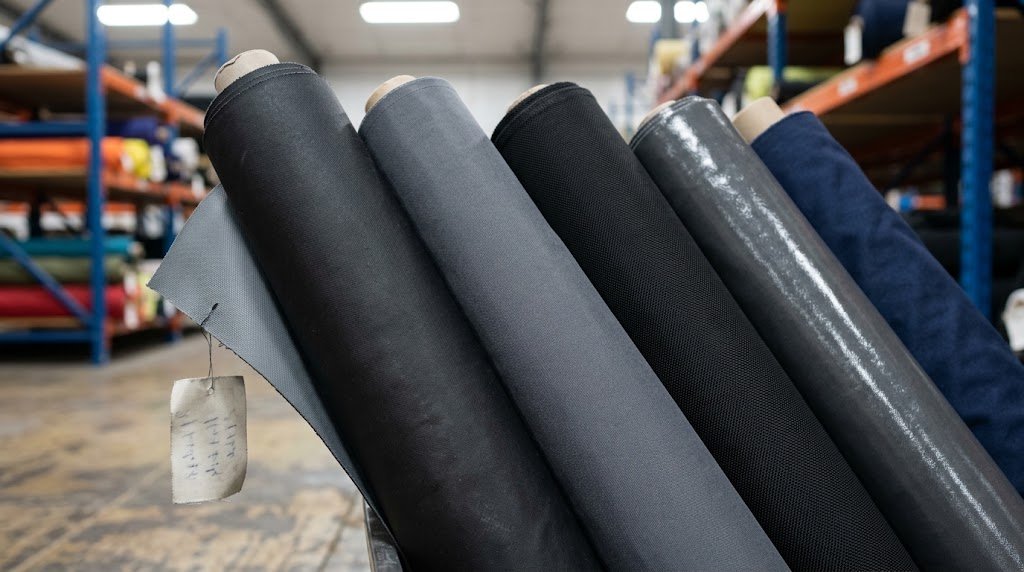
It’s tempting to assume price scales cleanly with denier (the thickness rating of the fabric — 600D, 900D, and so on), but in practice it doesn’t move in a straight line. Common deniers like 300D and 600D are mainstream, high-volume fabrics that most mills run constantly, so pricing between them tends to be close. Once you move up to 900D and beyond, fabric shifts into more of a specialty tier — lower production volume, less standardized supply — and the price gap widens more than the denier increase alone would suggest.
GSM (the fabric’s weight per square meter) and coating type often matter more than denier by itself. A heavier, PVC-backed 600D fabric can end up costing more than a lighter, PU-coated 900D fabric. If a quote seems to jump around when you change the fabric spec, this is usually why — it’s not one variable, it’s several stacked together.
Hardware: material, brand, and finishing all add up separately
Hardware: material, brand, and finishing all add up separately
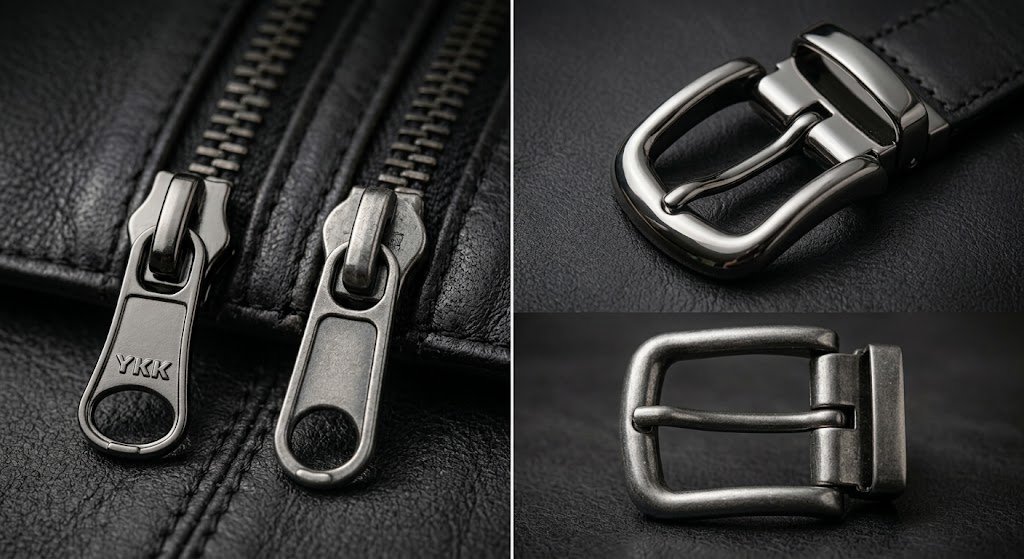
Hardware is where a lot of the real price movement happens, and it’s driven by three things that stack independently:
Material. Zippers, buckles, and D-rings made from brass or copper cost more than the same parts in standard steel or iron, simply because the raw material itself is pricier. This applies even before you get to branding.
Brand. Branded zipper systems like YKK or SBS cost more than generic equivalents of similar function — buyers are paying for consistent quality control and supply reliability, not just the zipper pull itself. In one recent order, switching to a YKK zipper added roughly $1 per unit to the total price — a meaningful jump for a single component change.
Plating method. Metal hardware is typically finished using either barrel plating vs. rack plating (parts tumbled in bulk through a drum, largely automated, versus parts hung and processed individually by hand). Barrel plating is the economical default for small hardware because it needs almost no manual labor. Rack plating can cost several times more in labor alone — but it isn’t reserved only for large or delicate parts. Buyers with strict quality or finish requirements will sometimes specify rack plating even on small hardware, because the manual process gives more consistent, higher-grade results. In practice, this shows up as roughly a 1.5-2x difference in the finished part’s contribution to price, not the full labor-cost multiplier, since plating is only one piece of the total component cost.
Compartments and structure
More compartments and interior layers mean more fabric, more zippers, more construction time — and the price climbs accordingly. A single-compartment daypack-style build and a multi-layer business backpack with a dedicated laptop sleeve, organizer panel, and separate accessory pocket are simply different amounts of bag, even before touching fabric grade or hardware.
Weight
Overall weight — a function of fabric GSM, padding, and hardware density — also factors into cost, both in raw material and in shipping. Heavier construction generally signals a higher-spec bag, but it also means the factory is using more of everything.
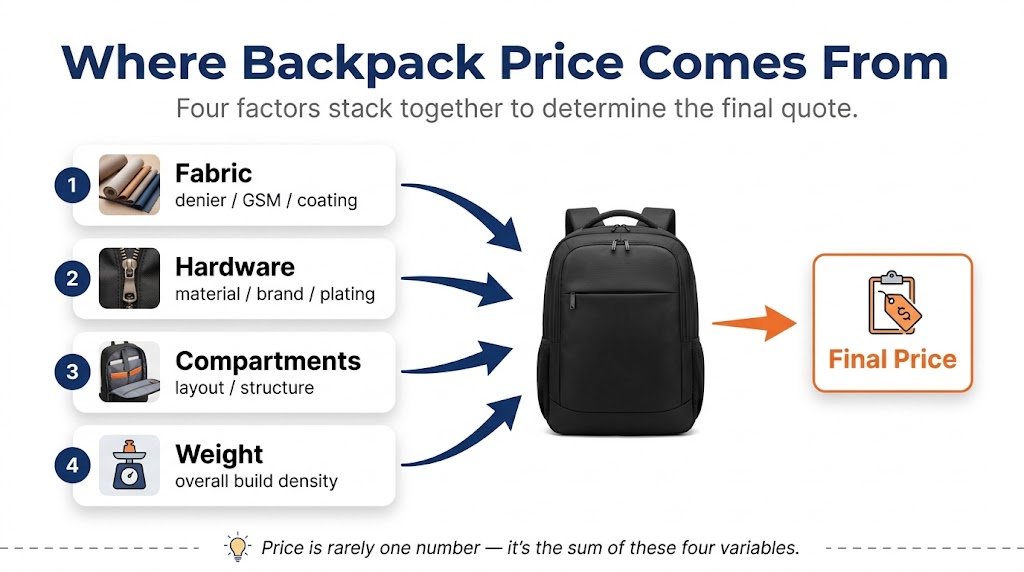
What Drives Custom Business Backpack Cost (and Why It Moves)Where $5-8 Comes From (and Why It Moves)
For a standard business backpack — solid mid-range fabric, generic or lightly-branded hardware, a reasonable but not excessive number of compartments — $5-8 per unit is a realistic factory-price starting point for decent quality. That’s the anchor, not a guarantee.
Push any of the factors above in one direction and the number moves with it. Add a YKK zipper, and you’re looking at roughly $1 more per unit right there. Specify rack-plated hardware, add a second interior compartment, or move up to a heavier-GSM coated fabric, and the total climbs further — sometimes past what a first-time buyer expects from a “simple” spec change.
The reverse is also true, and worth saying plainly: if a buyer wants the lowest possible price, that’s achievable too — thin fabric, minimal hardware, no reinforcement — but the resulting bag will reflect that. A very low quote isn’t automatically a red flag or a great deal; it might just be an accurate price for a thin, minimally-built bag. The number only means something in context of the spec behind it.
The Real Question: Does the Price Match the Bag?
This is the part most pricing guides skip, and it’s the most useful thing to walk away with: the goal isn’t to find the lowest price — it’s to confirm the price matches what you’re actually ordering.
A $5 quote and an $9 quote aren’t automatically “cheap” and “expensive.” They might both be entirely fair, for two different bags. The $5 version might be a lighter fabric with standard hardware and a single main compartment. The $9 version might carry a heavier coated fabric, a YKK zipper, rack-plated hardware, and a dedicated laptop sleeve. Comparing the two numbers without comparing the specs behind them tells you nothing useful.
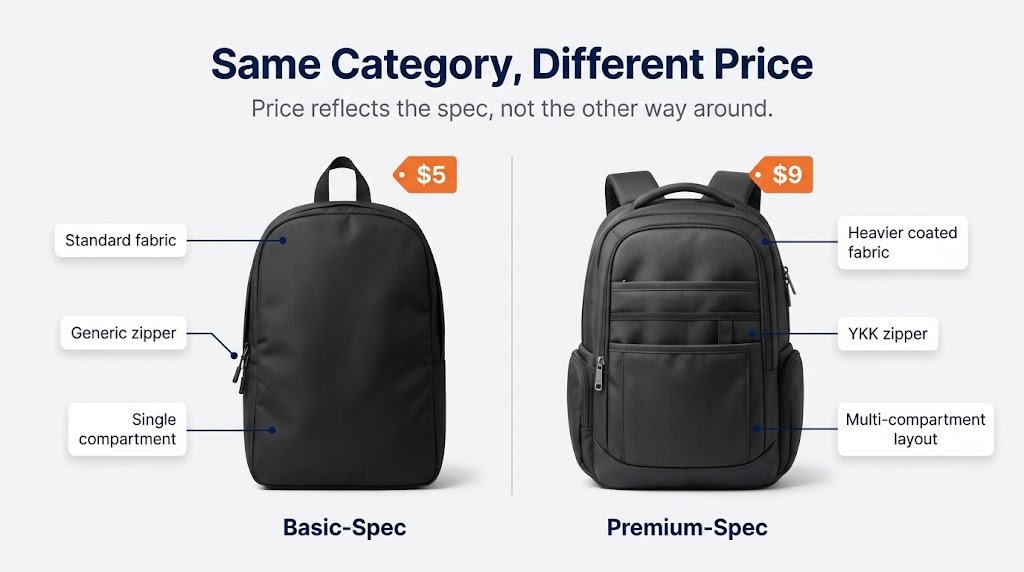
Before accepting or rejecting a quote, it’s worth asking the same questions from both directions:
- What denier and GSM is the fabric, and what coating (if any)? This alone can explain a meaningful chunk of a price gap between two quotes.
- Is the hardware branded (YKK/SBS) or generic, and what’s it made of? A quote using branded zippers should cost more — and if it doesn’t, that’s worth double-checking.
- Is the hardware rack-plated or barrel-plated? If a supplier can’t answer this, they may not know, or may not actually be able to guarantee the finish they’re quoting.
- How many compartments and layers does the spec include? Compare like-for-like structure, not just the headline price.
- Does the quote include everything, or are there costs added later? Confirm whether packaging, sample fees, and shipping are already factored in, or will show up as surprises after the order is placed.
A supplier who can walk through these points and explain why their number is what it is — rather than just handing over a flat quote — is generally a better sign than one offering the lowest number with no breakdown. For a broader checklist on vetting suppliers beyond just pricing, see our guide on how to evaluate a reliable bag manufacturer.
Frequently Asked Questions
What’s a realistic price for a custom business backpack? For decent, mid-range quality, roughly $5-8 per unit at factory price is a reasonable starting point. The final number depends heavily on fabric grade, hardware brand and finish, and how many compartments the design includes.
Why do backpacks with similar-looking specs sometimes have very different quotes? Usually because one or two components differ more than they appear to on paper — a branded zipper versus a generic one, or rack-plated versus barrel-plated hardware, can each shift the price meaningfully on their own.
Does a higher price always mean better quality? Not necessarily, but it usually corresponds to specific choices — heavier fabric, branded hardware, more complex construction, or higher-grade plating. The useful question isn’t “is this expensive,” it’s “does this price match this specific spec.”
Why did adding a branded zipper increase my quote by so much? Branded systems like YKK cost more for the material and manufacturing consistency behind them, not just the visible part. A roughly $1-per-unit increase for switching to YKK is a realistic, real-world example of how a single hardware change moves total cost.
Is the cheapest quote ever the right choice? It can be, if the spec behind it genuinely matches your needs — a simple, single-compartment bag with standard materials doesn’t need premium components. The risk isn’t a low price itself; it’s a low price that doesn’t match what you actually asked for.
Getting an Accurate Quote
The most reliable way to get a number you can actually trust is to send a full spec — fabric type and coating, hardware brand and finish, compartment layout — rather than asking “how much for a custom backpack” in general. Send your spec to our team for a transparent, itemized quote, or browse our Business Backpacks collection to see the material and hardware options that shape these numbers in practice.