
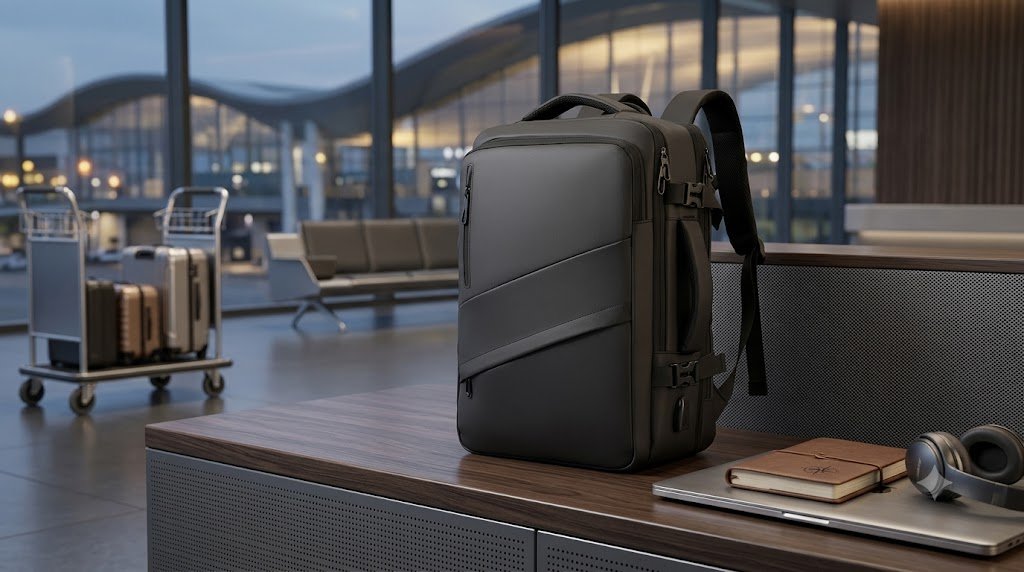
“Business backpack” and “travel backpack” used to mean two different products. Now buyers expect one bag to do both jobs — professional enough for a client meeting, functional enough for a red-eye flight. But most backpacks on the market aren’t actually built for that; they’re commuter bags with “travel” added to the marketing copy. Here’s what separates a genuinely dual-purpose design from one that just looks the part.
Why “Business Backpack” and “Travel Backpack” Are Merging Into One Category
A few years ago, these were fairly distinct products. A business backpack meant a laptop-focused commuter bag — professional look, padded sleeve, not much else. A travel backpack meant something built for airports and multi-day trips — larger capacity, more compartments, less concerned with looking polished in an office setting.
That distinction has largely collapsed. If you’re sourcing or buying a backpack for this category, understanding what a genuinely dual-purpose design requires makes a real difference in how well the product performs for its actual users — not just how it photographs.
1. Carry-On Dimensions: The Detail Most Bags Get Wrong
This is the single most common gap between a backpack that’s marketed as “travel-ready” and one that actually is. A lot of business backpacks are sized around what looks good and holds a laptop comfortably, without being checked against real carry-on allowances.
Requirements vary by airline and region, but as a general reference point, most European carriers allow cabin baggage around 55x40x20cm, while most major US and Canadian carriers (including Delta, United, American, and Air Canada) use a slightly larger standard of roughly 56x36x23cm (22x14x9 inches). If a backpack is being positioned for international business travel, its dimensions should be checked against the carry-on standards of its primary target market — not just scaled up from an existing commuter bag pattern.
For business travelers who need to pack more without sacrificing carry-on compliance, large capacity backpacks that are specifically engineered within carry-on dimensions solve this tension better than simply sizing up a standard design.
It’s also worth noting that resizing isn’t just a matter of scaling a pattern up or down. Internal components — laptop sleeve depth, compression strap anchor points, pocket placement — need to be re-verified at the new dimensions, or the bag can end up feeling disproportionate, with capacity that doesn’t match its external size.
2. Opening Style: Side-Opening vs. 180-Degree Bottom-Opening
Most backpacks in this category use a side-opening main compartment — it’s simpler and cheaper to construct, and it’s familiar to most users. But it has a real usability limitation for travel: reaching into a narrow side opening to find something at the bottom of a packed bag is awkward, especially when the bag is full.
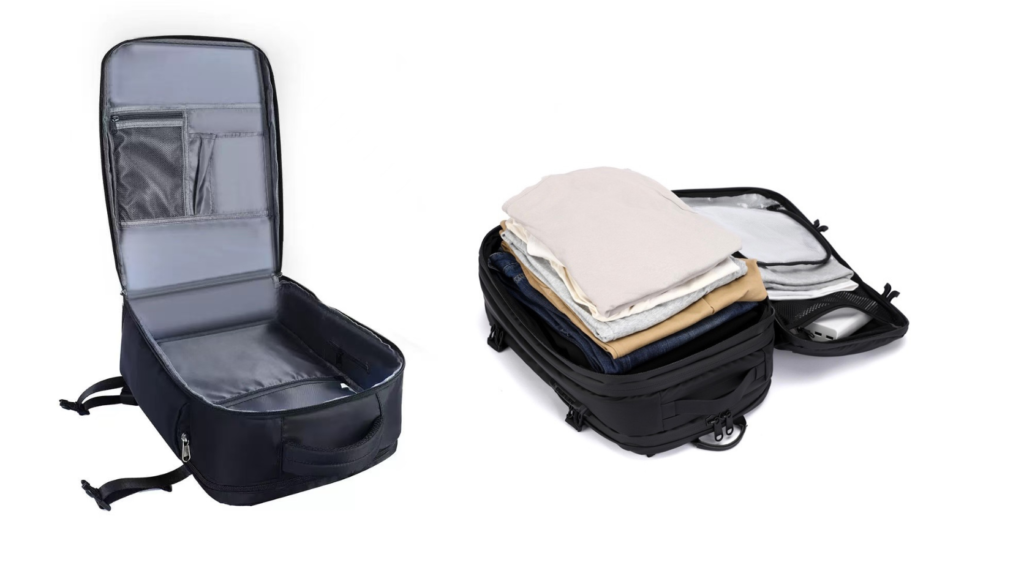
A 180-degree bottom-opening design solves this — the compartment folds fully flat, similar to how a piece of luggage opens, making it much easier to see and access everything at once. The tradeoff is construction complexity: this isn’t a simple zipper swap. The zipper track path, panel stitching along the opening seam, and any internal components anchored near the opening (like compression straps) typically need to be engineered together, since they all interact with how the compartment folds open.
If you’re evaluating backpacks — or having one developed — this is a detail worth asking about directly, since it affects both manufacturing cost and real-world usability more than it might seem at first glance.
3. Compression Straps: Surface-Mounted vs. Bottom-Deploy
Internal compression straps (usually in an X-pattern) help reduce a bag’s packed volume, which matters when you’re trying to fit a backpack into an overhead bin or just want to keep contents from shifting. Most backpacks use a surface-mounted strap layout — visible across the main compartment at all times.
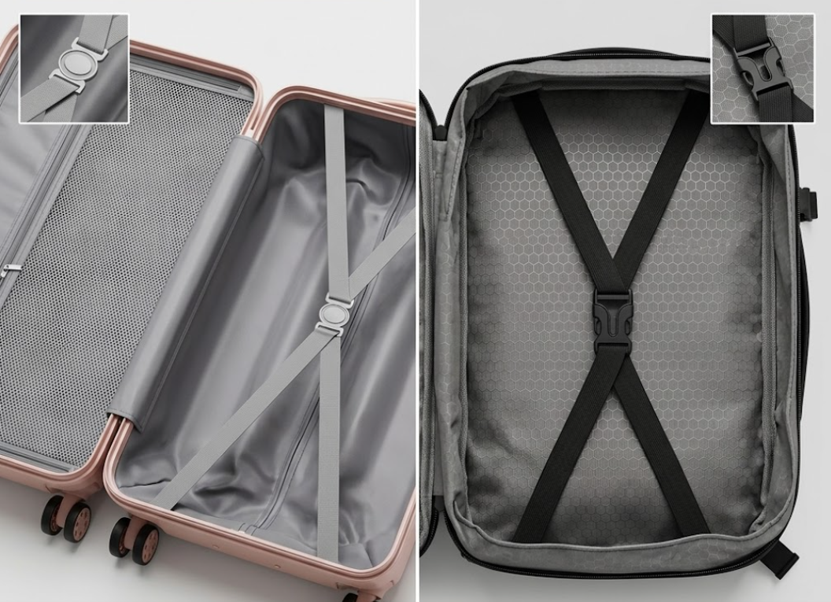
The downside: a surface-mounted strap is always in the way, even when you’re just grabbing a laptop or jacket during a normal commute. A better-engineered alternative deploys from the bottom of the compartment — staying tucked away during everyday use, but available to pull up and compress the bag’s contents when actually needed for travel. This is a more complex design to build, but it solves a real day-to-day annoyance that surface-mounted straps create.
For buyers looking for maximum packing efficiency, vacuum compression backpacks take this concept further — using a sealed compression system rather than adjustable straps to reduce packed volume, particularly useful for longer business trips where minimizing bulk matters more than everyday convenience.
4. Security Features Worth Considering
For a backpack genuinely positioned as a travel companion — not just a laptop bag with travel branding — a few security features signal that the product was designed with real travel use cases in mind:
- TSA-style combination locks, integrated at the main pocket opening, give a basic layer of security during transit without requiring a separate padlock purchase
- RFID-blocking pockets for passports and cards, relevant for travelers concerned about contactless skimming
- Lockable zipper pulls, which pair with a combination lock or standard padlock for additional peace of mind
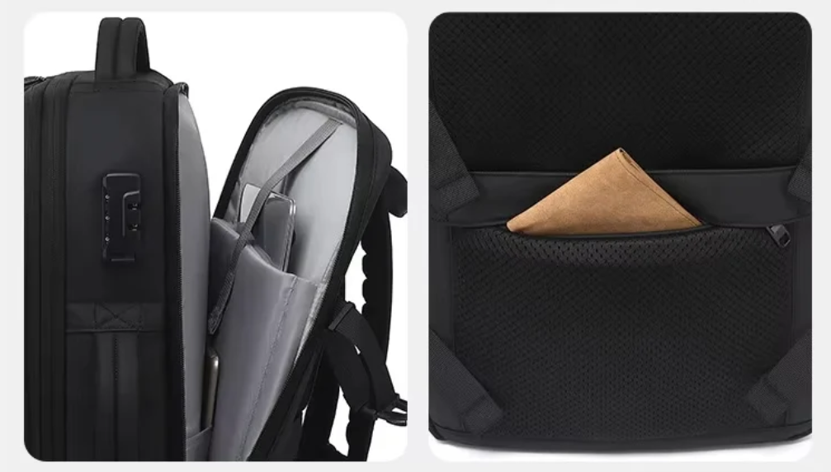
None of these are complicated to manufacture, but they’re the kind of detail that’s easy to skip if a bag wasn’t designed with a travel-specific brief from the start.
5. Tech Integration: Charging Ports and Tracker Pockets
Two features have moved from “nice to have” to close to standard expectation in this category:
USB charging access — typically an external port connected to an internal cable, allowing users to charge a device from a power bank inside the bag without opening the main compartment. This is a simple addition from a manufacturing standpoint, but it needs a durable cable — a cable that frays or wears out at the connector after a few months of daily use undermines an otherwise well-built bag.
Dedicated tracker pockets (most commonly for Apple AirTag) are an increasingly common request, particularly for travel-focused products. The better implementations use a detachable holder — often leather, with a metal snap-button closure — rather than a simple fabric slot. This gives the end user flexibility to remove the tracker when not needed, and it holds up better over repeated use than a slot sewn directly into the lining.
6. Retail-Ready Branding: Hangtags and Packaging
If a backpack is going to be sold on physical retail shelves — not just listed online — branding details that seem minor online become much more noticeable in person. A hangtag with thin, cheap-feeling paper stands out immediately when a customer is holding the product, in a way it never would in a product photo.
For retail-positioned products, it’s worth treating hangtag design, paper weight, and barcode placement as part of the product development process rather than an afterthought handled at the last minute. A separate travel luggage tag — distinct from the retail hangtag, sized and designed for identification during transit rather than in-store branding — is also common for products positioned specifically around travel use.
FAQ
What’s the difference between a business backpack and a business travel backpack? A standard business backpack is typically optimized for daily commuting — laptop protection, a professional look, moderate capacity. A business travel backpack adds features relevant to actual travel: carry-on compliant sizing, security features like combination locks, and often a more flexible opening and compression system for packing efficiently.
Do all business travel backpacks fit airline carry-on requirements? Not automatically. Carry-on allowances vary by airline and region, and many backpacks marketed as “travel-friendly” haven’t been specifically checked against these standards. It’s worth confirming exact dimensions against your target market’s typical carry-on allowances rather than assuming.
Is a 180-degree opening worth the extra manufacturing complexity? It depends on the target user. For a bag primarily used for daily commuting, a standard side-opening design is usually sufficient. For a bag positioned around travel — where users need to pack and unpack efficiently, often in tight spaces like an airport gate area — a 180-degree opening offers a meaningful usability improvement.
What should I ask a manufacturer if I want to develop a business travel backpack? Beyond material and construction quality, ask specifically about carry-on dimension verification, whether compression systems are surface-mounted or bottom-deploy, and how tech features (charging ports, tracker pockets) are integrated — these are the details that separate a genuinely travel-ready design from a commuter bag with travel branding added.
Quick Reference
A summary of what to check before choosing or developing a business travel backpack:
| Consideration | What to Look For |
|---|---|
| Carry-On Sizing | European airlines typically allow ~55x40x20cm; US and Canadian carriers typically allow ~56x36x23cm (22x14x9in). Confirm your target market’s standard before finalizing dimensions. |
| Opening Style | Side-opening is simpler to manufacture; 180-degree bottom-opening offers better packing access but requires more complex construction. |
| Laptop Protection | A padded, separate laptop compartment (ideally accessible without opening the main compartment) is standard for business use. |
| Compression | Internal compression straps reduce packed volume — useful for travel, less critical for daily commuting. |
| Security Features | TSA-style combination locks and RFID-blocking pockets are common asks from travel-focused buyers. |
| Charging Access | An external or internal USB charging port is now a near-standard expectation, not a premium add-on. |
| Tracking Compatibility | A dedicated pocket for an Apple AirTag or similar tracker is an increasingly common differentiator. |
Related Reading
For a real example of how these design considerations come together in an actual production project, see our case study on developing a business travel backpack for a European retail brand — from carry-on resizing and a 180-degree opening redesign to AirTag integration and scaling from a 500-unit trial order to container-scale production.
If you’re developing a custom business travel backpack and want to talk through carry-on sizing, opening mechanisms, or tech integration for your own product, get in touch with our OEM and ODM team for a free consultation.
Browse our current range of business backpacks and laptop backpacks to see the design details covered in this guide applied to real products.