
Quick Facts
| Item | Detail |
|---|---|
| Client Location | Netherlands |
| Client Type | Retail brand (online + offline distribution) |
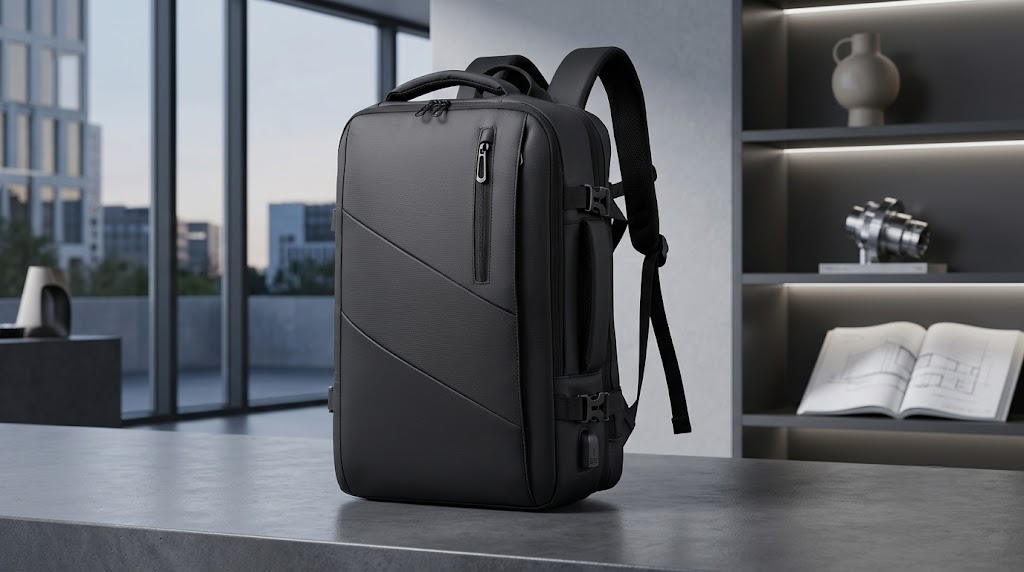
| Product | Custom travel/business backpack with integrated tech and security features |
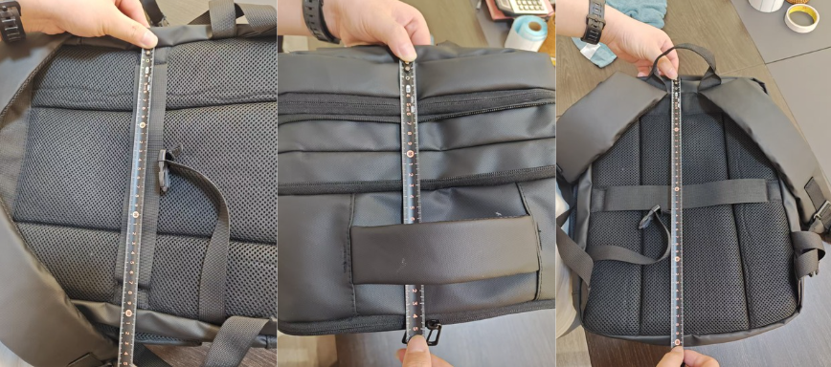
| Dimensions | Resized from an initial 40x20x30cm reference sample to a final 40x25x30cm, to align with European airline carry-on/flight travel standards |
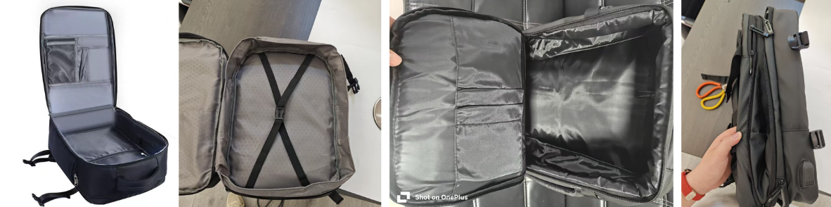
| Opening Mechanism | Redesigned from a standard side-opening main compartment to a 180-degree bottom-opening design |
| Key Custom Features | Detachable AirTag holder with snap-button closure, bottom-deploy internal X-strap compression system, TSA-style combination lock on the main pocket, USB charging port (a non-negotiable client requirement), upgraded USB cable material |
| Branding Work | Custom hangtag design (65x55mm) for retail branding, plus a separate travel luggage tag (11.5x7cm) for identification while checked in or in transit; multiple paper-weight and layout iterations |
| Shipment Method | Full container load (FCL) |
| Order History | Started as a 500-unit trial order; after strong sell-through, the client reordered multiple times, with total volume across all batches in the range of 2,000–3,000 units |
| Market Result | Became a best-selling SKU for the client, sold through both online and offline retail channels |
See It In Action
See the final production backpack — including the AirTag holder,
180-degree bottom opening, and compression strap system — in this walkthrough.
The Client
Our client is a retail brand based in the Netherlands, selling through both online e-commerce channels and physical retail stores. This dual-channel setup matters more than it might seem — a product that only needs to look good in a product photo is a very different design brief from a product that also has to hold up under fluorescent store lighting, survive being handled by dozens of customers a day, and compete on a shelf next to other brands.
Like many brands testing a new supplier relationship, this client didn’t start with a large commitment. They placed an initial trial order of just 500 units — enough to test real market response without overexposing themselves to a new product and a new manufacturing partner at the same time.
That first batch sold through well enough that the client came back with a reorder. Then another. Over several rounds, total volume across all batches grew into the 2,000–3,000 unit range, and the backpack became one of the brand’s best-selling products across both its online and offline channels — a trajectory that, in our experience, says more about a product’s real-world performance than any single large opening order could.
We’re sharing this project not because it’s the largest order we’ve handled, but because it illustrates something more useful to prospective buyers: what the relationship looks like when a small trial order is done right, and what kind of manufacturing partner can support that growth path without friction.
The Challenge
Because this product moved from a small trial order to a repeat, scaling SKU, the requirements evolved as the relationship developed rather than being fixed at the outset. Several details stood out as genuinely difficult to get right — not because any single one was complex on its own, but because they all had to work together in a bag that would be manufactured thousands of times identically.
1. Resizing for European Flight Travel Standards
The reference sample the client started from measured 40x20x30cm — a fairly standard backpack silhouette, but not one calibrated to European airline carry-on allowances. Since this product was being positioned as a genuine travel companion, not just a commuter bag with travel branding, the dimensions needed to change: expanding to a final 40x25x30cm, giving meaningfully more usable capacity while still fitting comfortably within the carry-on sizing most European airlines allow.
This kind of change sounds simple on paper — just “make it bigger” — but resizing a backpack isn’t just scaling the outer shell. Every internal component, from the compression strap anchor points to the AirTag pocket placement to the laptop sleeve proportions, has to be re-checked against the new dimensions so the bag doesn’t end up feeling awkwardly empty or disproportionate at the new size.
2. A Functional, Durable AirTag Pocket
The client wanted a dedicated pocket for an Apple AirTag — but not a simple fabric slot sewn into a side pocket, which is the easy, low-cost approach many factories default to. The brief called for a detachable leather AirTag holder with a metal snap-button closure, so end users could remove and reposition the tracker as needed, attach it to a different bag, or simply take it out when not traveling, while keeping it securely fastened during normal use.
The difficulty here isn’t the concept — it’s execution at volume. A snap-button mechanism that works smoothly on a hand-made sample can behave differently once it’s produced a few thousand times with normal manufacturing tolerances. Getting the stitching reinforcement and snap placement right so it holds up consistently, not just on the approved sample, was a real requirement, not a formality.
3. Changing How the Bag Opens — From Side-Opening to 180-Degree Bottom Access
The original reference sample opened from the side, in the way most backpacks in this category do. The client wanted something different: a main compartment that opens 180 degrees from the bottom, laying the bag fully flat for packing and unpacking, rather than reaching down into a narrow side opening.
This is a more significant structural change than it might sound like. Side-opening construction and bottom-opening construction distribute stress differently across the bag’s frame and zipper track, which meant the zipper placement, internal panel stitching, and even how the compression straps were anchored all had to be reconsidered together, not adjusted one at a time.
4. A Smarter Internal Compression System
Most backpacks with internal compression straps use a design where the X-strap sits on the surface of the main compartment, visible and slightly in the way when you’re just trying to grab a laptop or a jacket quickly. It’s the standard approach because it’s simple to construct. But it has a real usability downside for a bag that’s meant to be used every day, not just packed once for a trip.
The client wanted something more thoughtful: a compression strap system that stays out of sight when not needed, but can be deployed when extra compression is genuinely useful — for example, when packing for travel and wanting to reduce the bag’s overall volume for a plane’s overhead bin.
5. A Combination Lock for Travel Security
Since this was positioned as a travel-capable backpack — not just a laptop bag with “travel” in the marketing copy — the client selected a built-in 3-digit combination lock (TSA-style) as a security feature, mounted at the main pocket opening. It’s a detail that matters more to frequent travelers than it might seem at first glance, and one that signals the backpack was actually designed with real travel use cases in mind.
6. A Non-Negotiable USB Port, Upgraded Mid-Development
Early in development, the client was explicit about one thing: the external USB charging port was not up for discussion. It had to stay in the design, full stop — a rare case of a client flagging a feature as completely non-negotiable rather than something to evaluate case by case. Later in development, the client also requested an upgrade to the cable material itself, moving to a more durable option better suited to repeated daily use and less prone to wear or fraying at the connector points. This kind of request, arriving after the initial spec was already locked, is common in real development projects but easy for a factory to mishandle if their sourcing process isn’t flexible.
7. Branding at Retail Standard — Two Different Tags for Two Different Jobs
Since this backpack was sold on physical retail shelves as well as online, the hangtag needed to reflect the brand properly in person, not just function as a barcode holder. A hangtag that looks fine in a product photo can feel cheap in someone’s hands — thin paper, a flimsy string, colors that don’t quite match the brand. The client went through multiple rounds of hangtag design at a fixed 65x55mm size, testing different layouts and barcode placements, and comparing paper weight and thickness options side by side before finalizing the material.
Separately from the retail hangtag, the client also wanted a dedicated travel luggage tag — a different accessory entirely, sized at 11.5x7cm, meant to be attached to the bag for identification during checked travel rather than serving a retail branding function. Treating these as two distinct items with two distinct purposes, rather than trying to make one tag do both jobs, was part of the brief from early on.
Our Solution
Step 1 — Rebuilding the Bag Around New Dimensions
We took the 40x20x30cm reference sample and rebuilt it to a final 40x25x30cm, re-checking every internal component against the new proportions rather than simply scaling the pattern up. Laptop sleeve depth, compression strap anchor points, and the AirTag pocket position were all re-verified at the new size to make sure the extra capacity translated into genuinely usable space, not just a bigger-looking shell.
Step 2 — AirTag Holder Engineering
We developed a standalone leather AirTag holder with a metal snap button, attached to a reinforced strap loop on the backpack rather than an integrated fabric pocket. This approach has two advantages: it’s genuinely more durable at the stitching point, and it gives the end user flexibility to remove the holder entirely if they don’t use an AirTag.
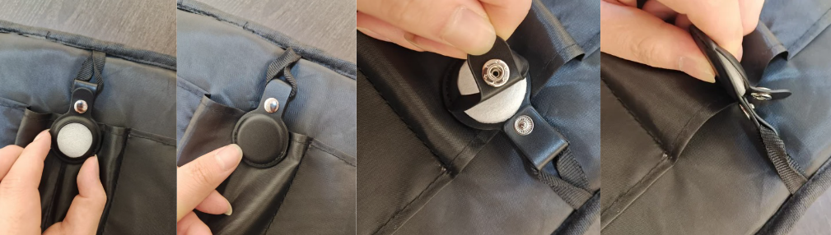
Reinforcement stitching around the loop was checked and adjusted through several review rounds, since this specific point takes the most repeated mechanical stress from daily attaching and detaching — far more than a typical zipper pull or strap adjuster sees over the same period of use. We treated it as an ongoing quality checkpoint through the sampling process rather than something to sign off once and move past
Step 3 — Re-Engineering the Opening Mechanism
Moving from a side-opening to a 180-degree bottom-opening design meant reworking the zipper track path, reinforcing the stitching along the new opening seam, and re-anchoring the internal compression straps so they still functioned correctly once the compartment could fold fully flat. We treated this as a structural change affecting the whole compartment, not an isolated zipper swap — every internal panel that touched the opening seam was reviewed as part of the same update.
Step 4 — Redesigning the Compression Strap for Real-World Use
Instead of the common surface-mounted X-strap layout, we engineered the compression system to deploy from the bottom of the compartment. When not needed, the straps sit flush and tucked away, so they don’t interfere with everyday access to the bag’s main contents. When needed, they pull up and across to compress the bag’s contents — giving the client’s customers the practical benefit of a luggage-style compression system without the everyday inconvenience of straps crossing the main compartment at all times.
This required more development iteration than a standard surface-mounted strap would have — an earlier configuration didn’t meet the client’s expectations for how cleanly the straps tucked away, and the anchor points had to be repositioned before the final version was approved. It’s a good example of a detail that looks minor in a spec sheet but takes real back-and-forth to get right in practice.
Step 5 — Integrating a Combination Lock
We sourced and integrated a 3-digit combination lock into the design at the main pocket opening, positioned for both security and ease of use, and tested for smooth operation of the resettable combination mechanism. This aligns with the brand’s positioning of this backpack as a genuine travel companion rather than just a daily commuter bag with a travel-themed name.

Step 6 — Keeping a Non-Negotiable Feature While Upgrading It
Since the USB port itself was a fixed requirement from day one, our focus wasn’t on whether to include it, but on how well it performed. When the client later requested a more durable cable material for the internal USB charging line, our sourcing team coordinated the swap with component suppliers directly, evaluating alternative cable materials for durability and flexibility before confirming the replacement. Because this was addressed as a targeted component change rather than triggering a full spec re-approval, it didn’t require restarting the broader development timeline — the rest of the bag’s construction continued on schedule while the cable material was finalized in parallel.

Step 7 — Hangtag and Luggage Tag Development at Retail Standard
We produced multiple hangtag design iterations at the confirmed 65x55mm size, including barcode placement testing and side-by-side paper stock comparisons, so the client could physically evaluate weight and texture before committing to a final material. We also tested different tag layouts against the brand’s visual identity to make sure the finished tag would look intentional next to competing products on a retail shelf, not like an afterthought printed to satisfy a barcode requirement.

In parallel, we developed the separate 11.5x7cm travel luggage tag as its own item, since it serves a different purpose than the retail hangtag — identification during transit rather than in-store branding — and finalized it alongside the main hangtag rather than treating it as a lower-priority afterthought.

Step 8 — Scaling From Trial to Full Container
Starting from a 500-unit trial order, we structured the reorder process so that each subsequent batch could scale smoothly without renegotiating specifications or requalifying materials from scratch. As order volume grew across multiple reorders, we consolidated shipments into full container load (FCL) shipping once volume justified it — reducing per-unit freight cost as the relationship scaled, rather than continuing with smaller, less efficient partial shipments indefinitely.
Why the Trial-to-Reorder Path Matters
We think this project is a more useful example for prospective buyers than a story about a single enormous first order. Most legitimate retail brands don’t want to commit to a large volume on a product they haven’t tested in market — and a manufacturing partner that only works well at large scale, or that makes small trial orders difficult and unattractive, isn’t actually solving the real problem most buyers have. This is exactly the kind of flexibility we built our OEM and ODM production process around.
What mattered in this relationship wasn’t just executing the initial 500-unit order correctly. It was:
- Keeping specifications and quality consistent across multiple reorder batches, so the product the client’s customers received in batch four was identical in quality to batch one
- Being able to absorb mid-development changes (the cable material upgrade) without those changes cascading into delays on reorders
- Scaling logistics intelligently — starting with smaller shipments appropriate to trial volume, then moving to full container shipping once order size justified it, rather than forcing one shipping method regardless of volume.
The Result
- What started as a cautious 500-unit trial order grew into repeat orders totaling approximately 2,000–3,000 units
- The backpack became a best-selling product for the client across both online and offline retail channels
- Resized the bag from 40x20x30cm to a final 40x25x30cm, aligning it with European airline carry-on standards without losing internal usability
- Re-engineered the main compartment from a side-opening to a 180-degree bottom-opening design, a structural change touching the zipper track, panel stitching, and strap anchor points
- Delivered a smarter, bottom-deploy compression strap system that improved on the common surface-mounted design
- Kept a client-mandated, non-negotiable USB port in the design while successfully upgrading its cable material mid-development
- Delivered retail-ready branding, including a fully finalized custom hangtag with client-approved paper stock
- Scaled shipping method appropriately as order volume grew, consolidating into full container load once volume justified it
FAQ
How do OEM factories typically handle a small trial order before scaling to full production? Many buyers start with a smaller trial batch to validate market demand before committing to larger volume. A good OEM partner should be able to support this scaling path — from trial order to reorder to full container — without requiring the buyer to renegotiate terms or specifications from scratch each time a reorder is placed.
Can a backpack be resized to fit European airline carry-on standards without losing capacity? Yes, but it requires more than scaling the outer pattern up or down. Internal components — laptop sleeve depth, strap anchor points, pocket placement — need to be re-verified at the new dimensions, otherwise the bag can end up feeling disproportionate or losing usable space relative to its new external size.
What’s involved in changing a backpack from side-opening to 180-degree bottom-opening? This is a structural change, not a simple zipper swap. The zipper track path, panel stitching along the new opening seam, and any internal components anchored near the opening (like compression straps) typically need to be reworked together, since they all interact with how the compartment folds open.
What’s the advantage of a bottom-deploy compression strap versus a standard surface X-strap? A surface-mounted compression strap is always visible and can get in the way when quickly accessing the main compartment during daily use. A bottom-deploy design stays tucked away during everyday use, but can still be pulled into position when extra compression is genuinely needed — for example, when packing for a trip and trying to reduce the bag’s overall volume.
Can a backpack factory customize hangtags and packaging for retail shelves? Yes. For products sold on physical retail shelves — not just online — hangtag size, barcode placement, and even paper weight and texture are usually part of the development process, since packaging quality is judged alongside the product itself in a retail setting, in a way it often isn’t for a purely online listing.
Is it possible to upgrade a component’s material mid-production without restarting the whole process? In most cases, yes. A material change to a single component, like a charging cable, can typically be coordinated with suppliers without requiring a full re-approval of the entire product, as long as it’s addressed as a targeted change early in the development cycle rather than discovered late in production.
Does reordering with the same factory guarantee consistent quality across batches? Not automatically — it depends on whether the factory treats specifications, materials, and quality checkpoints as fixed reference points across every batch, rather than re-approximating them each time. This is one of the most common places where quality drifts on repeat orders if it isn’t actively managed.
Why would a retail brand choose full container shipping over smaller partial shipments? Full container load (FCL) shipping generally reduces per-unit freight cost and simplifies customs clearance compared to multiple smaller shipments, but it only makes sense once order volume is large enough to justify a full container. Scaling from smaller shipments to FCL as volume grows is common for brands moving from trial orders into regular reorders.
Is This You?
If you’re a retail brand — online, offline, or both — and you’re looking for a manufacturing partner who can:
- Support you from a small trial order through to full-container production as demand grows, without making the early stages difficult
- Develop functional hardware and security details (tracker pockets, compression systems, combination locks) to a retail-ready standard, not just a working prototype
- Manage mid-development spec or material changes without derailing your timeline
- Maintain consistent quality across multiple reorder batches, not just the first sample
- Treat packaging and hangtags as part of the product experience, not an afterthought
Get in touch with the Nice Bags team for a free consultation and quote.