
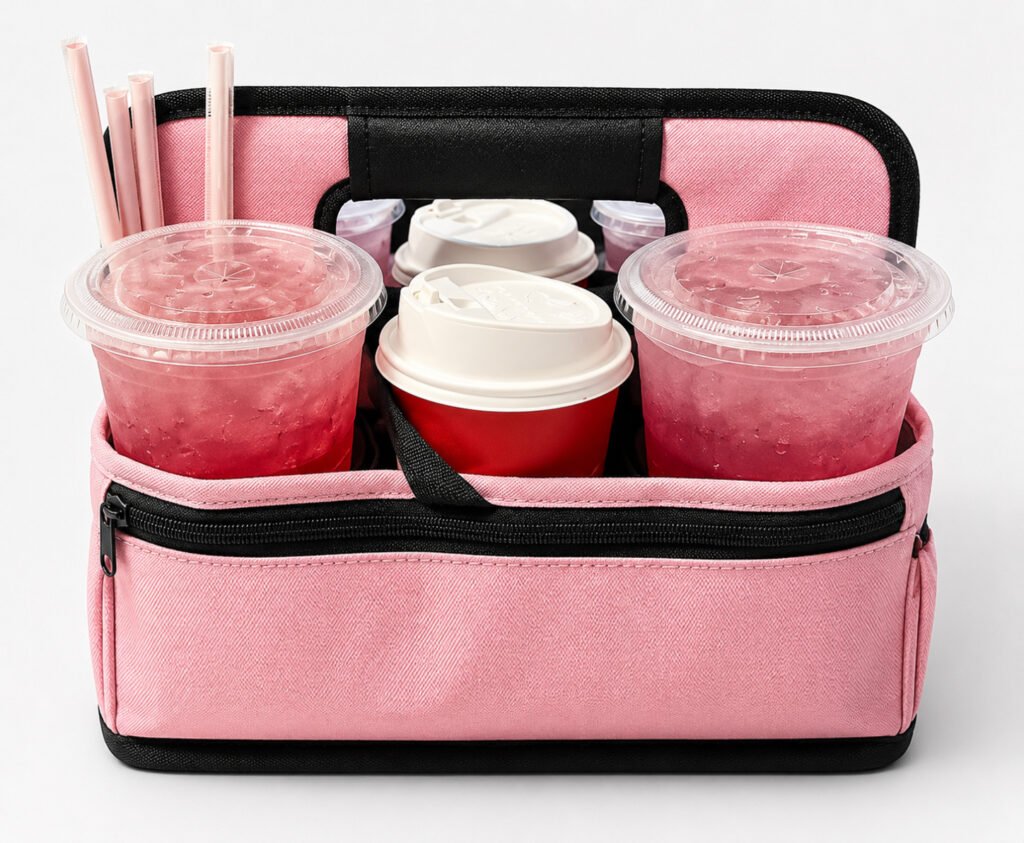
Client: US-based drinkware accessories brand
Product: Custom portable drink carrier totes (multi-cup capacity, two size variants) with a separately engineered padded carry handle
Order pattern: Multi-thousand-unit production runs, split across multiple colorways, placed on a recurring basis
Relationship: An ongoing, multi-year account — this drink carrier line is the anchor product in a broader working relationship that has included other bag styles for the same client
A Client Who Had Already Been Burned Once
This project didn’t start with blind trust. Before this client ever sent us a spec sheet, they had already been through a vendor search that didn’t go smoothly — a prior supplier candidate had produced samples and documentation that didn’t hold up, and the client had commissioned an independent, third-party quality inspection to understand exactly where that vendor fell short before committing to anyone new.
By the time the project reached us, the client wasn’t shopping on price alone. They came in with a detailed, dimensioned product specification, a fixed production calendar, and a clear set of expectations for how prototypes, pricing, and evaluation would be handled before an order was placed. We aren’t going to walk through that prior vendor’s specific failures here — that’s not our story to tell — but the caution behind it shaped how we approached the entire relationship: precise adherence to spec, documented measurements at every stage, and no shortcuts on packaging or labeling details that a less careful factory might treat as an afterthought.
That approach is what turned a single cautious first order into a standing annual reorder.
The Product: Two Components, Engineered Together
The drink carrier is built from two parts that both needed to work — not just individually, but together.
The carrier body is a structured fabric tote available in two capacities (a smaller multi-cup size and a larger one), built around a consistent internal footprint so that cups sit securely rather than shifting in transit. The interior uses a grey, water-resistant lining material, with hook-and-loop (Velcro) elements used to help hold cups in place — a small detail, but one that matters when the product is carrying hot liquid across a parking lot rather than sitting on a shelf. Every unit carries two distinct pocket types on the exterior: an elastic single-cup side pocket sized to hold an additional drink with enough give to open without stretching out of shape, and a full-width zip pocket across the back for small accessories, sized proportionally to each carrier — wider on the larger capacity, narrower on the smaller one, but always running the full width of the back panel. Both pocket types are standard across every colorway and every size — not an upsell option — which meant our pattern-making had to hold up consistently across eight different colorways without the fit or pocket depth drifting from batch to batch.
The carry handle is its own separately developed component: a padded, neoprene-wrapped handle built to stay comfortable and structurally stable under a full load of drinks, rather than simply being an extension of the body fabric. Getting a handle to hold its shape, sit flat against the frame, and avoid twisting under load is a different engineering problem from building the tote body — which is why we treated it as one.
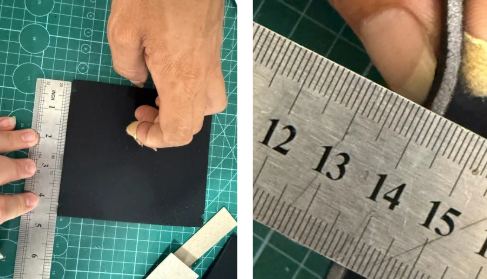
Getting the Handle Right: A Multi-Round Prototyping Process
The handle went through several rounds of physical sampling before it was approved — cutting, ruling, and hand-fitting the neoprene shell around the internal support piece, checking dimensions against spec at each stage rather than eyeballing it. We built and measured multiple width and curvature variations before landing on a version that held its shape without adding unnecessary bulk or weight to the finished bag.
This kind of iterative, physical prototyping — building the part, measuring it, adjusting it, and building it again — is standard practice on any component that has to do real mechanical work (in this case, staying rigid enough to carry a loaded drink caddy comfortably) rather than just look right in a product photo. It’s a slower process than approving a single sample off a drawing, but it’s the difference between a handle that photographs well and one that actually holds up in daily use.
The handle’s outer shell is neoprene — a rubber-based, elastomeric material that stretches and recovers under tension, which is exactly what makes it comfortable to grip but also what makes it tricky to cut accurately. Most factories die-cut neoprene in large stacks — five, ten, sometimes more layers at once — to save time. The problem is that neoprene under that much compression shifts and “snaps back” once the pressure is released, leaving edges that curl or panels that come out slightly out of true. We limit ourselves to two or three layers per die-cut pass on this component specifically to avoid that distortion — slower per cut, but the panels come out flat and consistent, which matters when the handle has to sit square against the frame across thousands of units.

Production at Scale: Multiple Colorways, One Repeating Schedule
Once the design was locked, production moved onto a structured, repeating schedule rather than a single one-off run. Each production cycle is split evenly across all eight colorways and both size variants, with a fixed calendar the client can plan their own retail timing around — proposal and prototype deadlines, a defined evaluation window, a production start date, and a firm completion date before goods move to the warehouse.
That structure has scaled with the relationship. What began as a single multi-thousand-unit order has grown into a recurring annual commitment, with the client placing follow-on orders on essentially the same cadence — proof that a first order built on a tight spec and a cautious buyer can turn into a standing account when the execution holds up run after run.
Quality Control You Can Measure, Not Just Claim
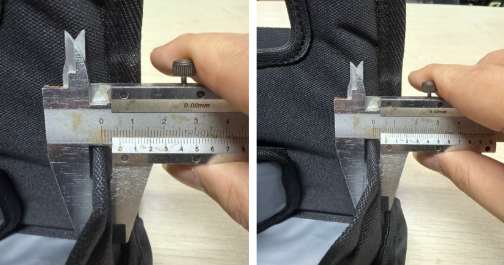
Because this client’s prior experience had specifically involved specification and measurement problems, we built extra rigor into this project’s quality checks rather than relying on a single end-of-line inspection. Material thickness on the padded and lined components is checked with digital calipers during production, not estimated by eye. Carton packing, inner packaging weights, and barcode-to-carton matching are checked against the client’s own packing specification before goods are palletized, since mislabeled or unmarked cartons are exactly the kind of detail that causes real problems at customs and at the client’s warehouse — and exactly the kind of detail an inspector will always find if you get it wrong.
The client also specifically requested vacuum-compressed packaging to cut down shipping volume — a meaningful cost saving on a product that ships by the thousands. This is a genuinely awkward product to vacuum-pack: the carrier’s irregular, multi-cavity shape (four or six cup wells, a raised handle, uneven panel heights) creates far more corners and pressure points than a flat item, and every one of those points is a place where a vacuum seal can puncture or slowly lose air. Air leakage was the client’s biggest concern, based on experience with this exact packaging challenge on past orders — a bag that isn’t sealed properly doesn’t stay compressed, which defeats the purpose and creates inconsistent carton dimensions across a shipment.
We source the thickest vacuum bag film available on the market for this product specifically, rather than a standard-gauge film, precisely because the carrier’s shape puts unusual stress on the seal at its corners and cup-well seams. Every roll is checked with digital calipers before use to confirm it meets spec — this is a case where “thick enough” isn’t a guess, it’s a measured requirement. This client is particular about the detail for good reason, and as far as we’re aware, we’re currently the only supplier meeting it consistently on this product.
From First Order to a Standing Part of the Business
This drink carrier line is one of several products we’ve produced for this client over the course of the relationship — including other bag styles developed and tested alongside it. It’s the one that has anchored a multi-year, recurring manufacturing relationship, with the client returning for a new production cycle on a fixed annual schedule. That’s the outcome we’re actually optimizing for on every project — not a single successful order, but a client who comes back on a schedule because the execution was dependable the first time and every time after.
Production Snapshot
| Detail | Spec |
|---|---|
| Product | Custom portable drink carrier tote, two size variants |
| Components | Structured fabric carrier body + separately engineered padded handle |
| Colorways | 8 colorways offered consistently across both sizes |
| Interior | Water-resistant lining, hook-and-loop cup retention |
| Exterior features | Elastic single-cup side pocket + full-width rear zip pocket (standard on every unit) |
| Order pattern | Multi-thousand-unit production runs, split evenly across colorways |
| Reorder cadence | Recurring annual production cycles on a fixed calendar |
| Relationship | Multi-year account, multiple product lines developed for the same client |
Why This Project Is a Good Example of How We Work
- We take spec-driven clients seriously. When a client arrives having already been let down elsewhere, they’re not being difficult — they’re telling you exactly what to get right. We built our process around their documented expectations rather than asking them to trust us blind.
- We engineer components separately when they need to be. The carry handle isn’t an afterthought stitched onto the body — it went through its own multi-round prototyping process because it has to do real structural work.
- Consistency across colorways and batches is a discipline, not a given. Eight colorways, two sizes, the same pocket specs on every single unit, run after run — that only holds up with tight pattern control, not luck.
- Measurement replaces guesswork. Material thickness, carton weights, and barcode accuracy are checked with instruments and against a spec sheet, not approved by eye.
- We solve packaging problems other suppliers won’t take on. Vacuum-sealing an irregularly shaped, multi-cavity product without air leakage isn’t a standard packaging job — it took sourcing heavier-gauge film than most suppliers stock and testing every roll against spec. It’s the kind of requirement that’s easy to shrug off, and as far as we know, we’re currently the only supplier meeting it consistently on this product.
- We work within real-world cost constraints, not just ideal ones. Like any brand scaling a product line, this client needs the unit economics to work at volume — pricing has to stay disciplined for the business to make sense. That’s the kind of constraint that tends to tempt a supplier into quietly cutting a corner somewhere — a thinner film here, a skipped measurement there. We didn’t. Every process improvement in this case study — the film thickness, the layer-limited die-cutting, the compression testing — held regardless of the price point, which is a large part of why the relationship has lasted.
- A repeat order is the real scorecard. This client didn’t just approve one production run — they’ve kept coming back on a recurring schedule, which is a better indicator of a manufacturing relationship’s quality than any single case study can be.
FAQ
What is a portable drink carrier / cup carrier tote? A portable drink carrier is a structured fabric tote designed to hold multiple beverage cups securely for transport — commonly used by coffee and beverage brands as a retail accessory or giveaway item. Well-built versions use a padded handle and interior fasteners (like hook-and-loop straps) to keep cups from shifting or tipping during carry.
Can Nice Bags develop a product with more than one engineered component, like a bag body plus a separate structural handle? Yes. On this project, the carrier body and the padded handle were developed as two separate components with their own prototyping and approval process, then engineered to work together — which is our standard approach whenever a product has a part that needs to do real mechanical work rather than just attach to the main body.
Do you support recurring or annual reorder production, not just one-off runs? Yes — this case study is a direct example. This client’s drink carrier line has moved from an initial order to a recurring annual production cadence across multiple colorways, run on a fixed calendar the client can plan their retail timing around.
How do you handle quality control for clients who’ve had bad experiences with a previous factory? We build extra measurement and documentation into the process rather than relying on a single final inspection — checking material specs with instruments like digital calipers during production, and verifying packaging, labeling, and carton details against the client’s own specification before goods are palletized.
What is the minimum order quantity for a custom drink carrier or multi-cup tote? Order sizes vary with colorway count, component complexity, and tooling requirements. This particular account runs multi-thousand-unit production cycles split across eight colorways; smaller initial orders are workable for evaluation before scaling into a recurring schedule. Contact us with your target quantity and colorways for a specific quote.
Interested in developing a custom drink carrier, cup holder tote, or another accessory product for your brand — or evaluating a new factory after a supplier didn’t work out? Get in touch with our team to discuss your idea, MOQ, and timeline.