
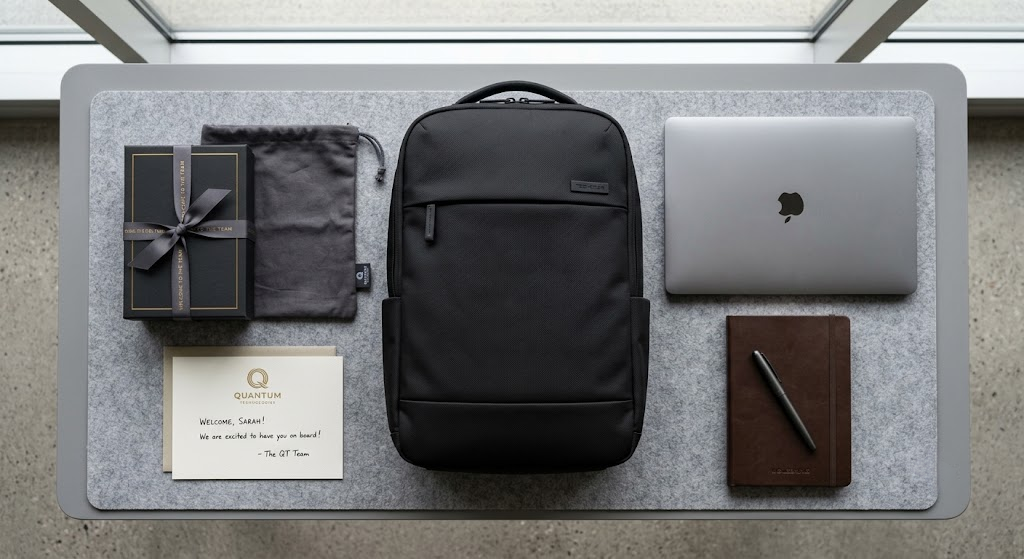
A practical playbook for procurement managers, HR directors, and brand teams sourcing custom corporate backpacks for onboarding, employee gifts, or executive appreciation.
Sourcing a custom corporate backpack means balancing four things: material specification, budget tier, production timeline, and supplier vetting. Get any one wrong — a cheap zipper, a compressed timeline, an unverified factory — and a branded backpack meant to represent your company ends up undermining it instead. Get it right, and you’ve created a daily-use item people actually keep for years.
This guide covers how to write an RFQ spec sheet, what to budget per unit, how long real production takes, the most common sourcing mistakes, and the questions to ask any OEM/ODM backpack manufacturer before signing a purchase order.
1. The Spec Sheet: What to Put in Your RFQ
A complete backpack RFQ defines six things: laptop compartment structure, fabric grade, strap/back panel design, hardware brand, branding method, and packaging. Vague specs are the #1 reason bulk orders come back disappointing — define these before you request quotes.
| Category | Basic Option | What We Recommend for Corporate Orders |
|---|---|---|
| Laptop compartment | Flat sleeve touching the bottom | Suspended, shock-proof sleeve — 10mm EVA foam floating 15mm above the base, fitted for 16″ laptop backpacks |
| Fabric | 300D/600D polyester | 900D matte-coated polyester or 1680D nylon for structure and water resistance |
| Straps & back panel | Standard S-curve, basic mesh | 65mm+ strap width, 12mm high-density foam, airflow channels, trolley pass-through |
| Hardware | Generic zinc pulls, nylon coil zips | YKK/SBS #8–#10 water-resistant reverse coil zippers |
| Branding | Silk screen or embroidery | “Quiet branding” — 3D silicone patch, debossed leather badge, or tone-on-tone stitching |
| Packaging | Bulk polybag, compressed | Individual dust bag + flat carton (prevents creasing before an event) |
Manufacturer’s tip — the “floating laptop compartment”: Most off-the-shelf bags place the laptop sleeve directly on the bottom seam, so a drop sends the impact straight to the device. A suspended sleeve, cushioned in EVA foam and raised above the floor of the bag, is a small spec change that meaningfully cuts damage claims.
2. What Should You Actually Spend Per Unit?
Custom corporate backpacks fall into three budget tiers: $10–$18 for mass events, $18–$35 for standard corporate gifting, and $35–$55+ for executive/VIP gifts. Budget dictates materials and branding options more than almost anything else. Here’s how each tier breaks down:
Tier 1 — $10–$18: Mass Events & Giveaways
Trade shows, university kits, large-scale promo drops.
- 300D–600D polyester, single compartment, basic 14″ laptop sleeve
- 1-color silk-screen logo, standard polybag packaging
Tier 2 — $18–$35: Standard Corporate & Onboarding
New-hire kits, annual gift programs, team rewards — this tier overlaps well with our business backpack range.
- 840D–900D nylon/matte polyester, dual compartments, suspended 16″ laptop pocket
- Hidden AirTag pocket, YKK zippers, luggage strap
- Silicone patch or woven label, hangtag, individual polybag
Tier 3 — $35–$55+: Executive & VIP Gifting
Client appreciation, leadership summits, premium gifts — often built on our hard-shell backpack or large-capacity silhouettes.
- 1680D ballistic nylon or GRS-certified recycled nylon, waterproof zippers
- Molded front shield, modular internal pouches, padded leather handle
- Gunmetal badge or debossed leather patch, dust bag + optional gift box
3. Timeline: Budget 8–12 Weeks, Not 4
A custom backpack order of 500–5,000 units realistically takes 8–12 weeks from RFQ to delivery. Late delivery is the most common failure point in corporate gifting — here’s the actual schedule, stage by stage:
| Stage | Time | What Happens |
|---|---|---|
| RFQ & requirements | 3–7 days | Tech pack, fabric choice, target price, logo files finalized |
| Sample development | 7–12 days | Pattern-making, fabric sourcing, prototype sewn |
| Sample approval | 5–10 days | Physical sample shipped, reviewed, signed off |
| Bulk material sourcing | 12–18 days | Fabric weaving/dyeing, hardware molding, certifications verified |
| Mass production & QC | 20–30 days | Cutting, sewing, logo application, inline + final inspection |
| Shipping | 7–35 days | Air freight (7–10 days) or ocean freight (25–35 days) |
Rule of thumb: Set your target delivery at least 10–14 days before the actual event date. That buffer absorbs customs delays, weather, and internal distribution time — without it, one hiccup anywhere in the chain becomes your problem the week of the event. See more on how our factory production process is structured to hit these windows reliably.
4. Three Mistakes That Ruin Corporate Backpack Orders
Mistake #1: Dense embroidery on waterproof fabric. Embroidery needles punch thousands of tiny holes through the fabric, breaking the waterproof coating right where the logo sits — so water leaks in exactly where your branding is. Use a heat-sealed silicone patch or debossed leather patch instead; it preserves waterproofing and looks more premium.
Mistake #2: Not specifying packing method. Left to default, factories fold and vacuum-compress bags to save freight space — bags then arrive creased and wrinkled, which looks bad the moment you hand them out at an event. Specify flat-lay packing with silica gel and tissue fill in your PO up front.
Mistake #3: Adding an external USB charging port. Once a popular “tech” feature, exposed USB-A ports now read as dated and break down with regular use. A hidden internal tech pouch with an AirTag slot serves the same purpose more durably.
5. 2026 Design Trends Worth Knowing
- Quiet branding. Oversized screen-printed logos are out; matte metal badges, tonal embroidery, and debossed silicone patches are in — especially for tech and finance clients.
- Hybrid-work mobility. Bags need to move seamlessly from home to office to airport: clam-shell opening, TSA-friendly laptop access, hidden passport pockets.
- Verifiable sustainability. “Eco-friendly” claims alone don’t cut it anymore — ask for a Transaction Certificate (TC) proving GRS-certified recycled content. See our own certifications for reference on what this documentation looks like.
6. 15 Questions to Ask Before You Sign With a Supplier
- Can you provide a certified tech pack and bill of materials before sampling?
- What’s your MOQ for custom fabric colors vs. stock colorways?
- Do you issue GRS or OEKO-TEX certificates for recycled fabric?
- Which zipper brand do you use as standard (YKK, SBS, KCC)?
- What load-testing do you run on shoulder straps and seams?
- Do you provide a physical pre-production sample before mass cutting?
- What’s your defect-rate policy, and how are replacements handled?
- Do you run inline AQL 2.5/4.0 inspections during assembly?
- Can you support custom lining, zipper pullers, and dust bags?
- How do you pack finished goods to prevent creasing in transit?
- What’s your daily production capacity?
- What are your payment terms for custom OEM orders?
- Are your facilities SEDEX, BSCI, or ISO9001 audited?
- How is IP protected on proprietary designs?
- What’s the cost difference between air and sea freight for our volume?
7. What You Can (and Can’t) Easily Customize
Low cost, low MOQ: Fabric colors from stock cards, logo method (patch/embroidery/print/deboss), zipper puller shape/color, lining color, hangtags and packaging.
Moderate cost, higher MOQ required: Custom Pantone fabric dyeing (1,000m+ MOQ), custom metal molds for hardware ($150–$300 mold fee), custom TPU coating or woven patterns.
Not practical under 1,000 units: New molded EVA front panels ($2,000+ mold fees), major structural redesigns on short lead times.
8. Which Sourcing Path Fits Your Project?
- Event in under 4 weeks, or fewer than 200 units → Stock blank backpack + custom logo application (fastest turnaround)
- 300–1,000 units, onboarding or annual gifts → Semi-custom ODM (modify a stock design’s fabric, lining, and hardware)
- 1,000+ units, premium or executive gifting → Full custom OEM development (custom tech pack, fabric, and molds)
9. Inspection Checklist (AQL 2.5 Standard)
When your shipment arrives — or you’re reviewing a third-party inspection report from our factory production team — check these five things:
| Category | Standard |
|---|---|
| Construction | No loose threads over 3mm, no skipped stitches, 7–8 stitches/inch, no fabric shade variation |
| Zippers | Smooth operation across corners, no snagging, pullers locked firmly |
| Stress points | Bar-tack stitching (28+ stitches) at handles, strap joins, sternum strap |
| Branding | Logo placement within ±2mm, color matched to Pantone under D65 light |
| Cleanliness | No chemical odor, no oil stains or chalk marks, pockets free of debris |
Frequently Asked Questions
More questions? Browse our full FAQ resource or contact our team directly.
How much does a custom corporate backpack cost per unit? Custom corporate backpacks typically range from $10–$18 for mass giveaways, $18–$35 for standard corporate/onboarding gifts, and $35–$55+ for executive or VIP-tier bags. Price is driven mainly by fabric grade, zipper hardware, and branding method.
How long does it take to produce custom branded backpacks? A custom OEM backpack order of 500–5,000 units typically takes 8–12 weeks from RFQ to delivery, covering sampling, approval, bulk material sourcing, mass production, and shipping. Add 10–14 days of buffer before your event date to absorb shipping or customs delays.
What is the minimum order quantity (MOQ) for custom backpacks? MOQs vary by customization level. Logo application on a stock blank bag can often be done at low volume (under 200 units). Custom fabric colors or dyeing usually require 1,000+ meters of fabric, and custom hardware molds typically need volumes in the thousands to be cost-effective.
What’s the difference between semi-custom (ODM) and full custom (OEM) backpacks? Semi-custom ODM means modifying an existing stock design’s fabric, lining, and hardware — suited to orders of 300–1,000 units. Full custom OEM means building a backpack from a new tech pack, fabric, and molds — typically only cost-effective above 1,000 units.
Why do embroidered logos leak on waterproof backpacks? Embroidery needles puncture the fabric’s waterproof coating, so water can seep through at the logo. Silicone patches or debossed leather patches preserve waterproofing and are the standard alternative for water-resistant bags.
What certifications should I ask a backpack supplier for? Ask for GRS (Global Recycled Standard) or OEKO-TEX certification if sustainability claims matter, and SEDEX, BSCI, or ISO 9001 factory audit documentation to verify ethical and quality-control standards.
The Bottom Line
The corporate gifting projects that go smoothly are the ones where procurement brings the factory in early — during design, not four weeks before the event. Nail the spec sheet, budget realistically for your tier, and build in a real timeline buffer, and you’ll end up with a backpack people actually keep using long after the free-swag pile gets thrown out.
Ready to start? Browse our corporate backpack range or get in touch with our team to scope your project. You can also learn more about Nice Bags and our manufacturing background.