
If you’ve spent any time sourcing custom business backpacks, you’ve seen the phrase everywhere: “Flexible MOQ.” It’s on nearly every manufacturer’s homepage, every Alibaba listing, every cold email from a sourcing agent. And yet, ask any procurement manager who has actually gone through the process, and you’ll hear the same complaint: they reached out to five “low MOQ” suppliers, and four of them came back with a quote requiring 500+ units the moment any real customization entered the picture.
(For readers new to the term, MOQ, or minimum order quantity, refers to the smallest number of units a supplier will accept in a single order.)
This gap—between what “flexible MOQ” promises and what it actually delivers—is one of the most common frustrations in B2B backpack sourcing. It’s not that suppliers are lying, exactly. It’s that the phrase means different things to different factories, and buyers rarely find out which definition they’re dealing with until they’re already deep into a quote negotiation. (For a broader overview of the entire sourcing process, see our complete B2B sourcing guide for custom business backpacks.)
This guide breaks down where MOQ actually comes from, what “flexible” really means in practice, realistic MOQ ranges by customization level, and the questions you should ask before trusting any supplier’s claim.
Quick answer: “Flexible MOQ” usually refers to low minimums for logo-only customization (50–100 units), not full custom development. Realistic MOQ ranges by customization level: logo-only (50–100 units), custom fabric color (200–500 units), custom hardware finish (300–800 units), structural customization (500–1,000+ units), full custom development (800–1,500+ units). Manufacturers with in-house fabric dyeing and hardware electroplating can offer lower minimums because they aren’t bound by third-party mill or plating vendor MOQs.
Why MOQ Exists in the First Place
To understand whether a “flexible MOQ” claim is real, you first need to understand where MOQ comes from—because it rarely originates with the backpack factory itself.
Every custom backpack is built from components sourced further up the supply chain: fabric, zippers, hardware, webbing, linings. Each of these has its own minimum order requirement, set by the mills and workshops that produce them, not by the bag factory assembling the final product.
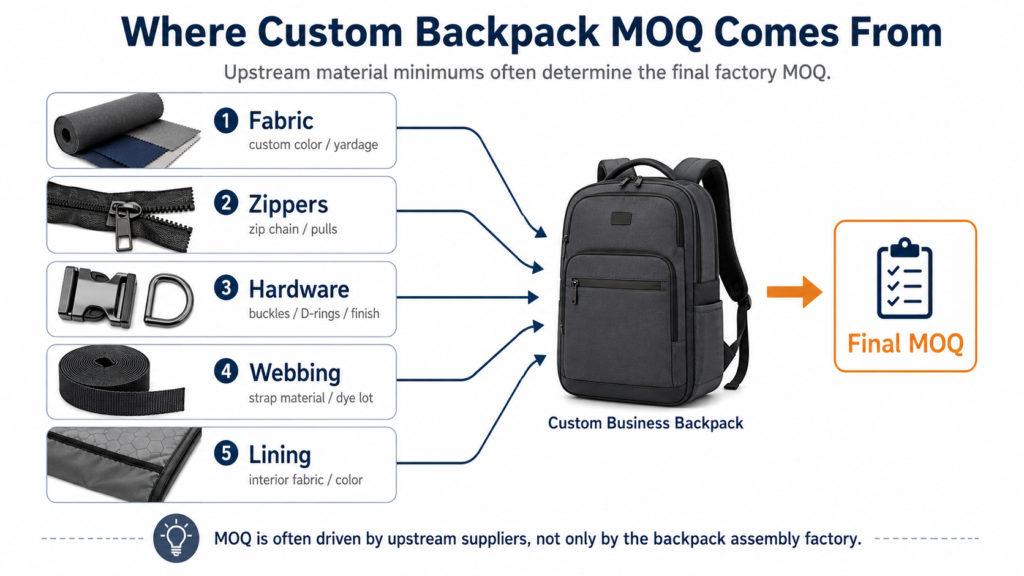
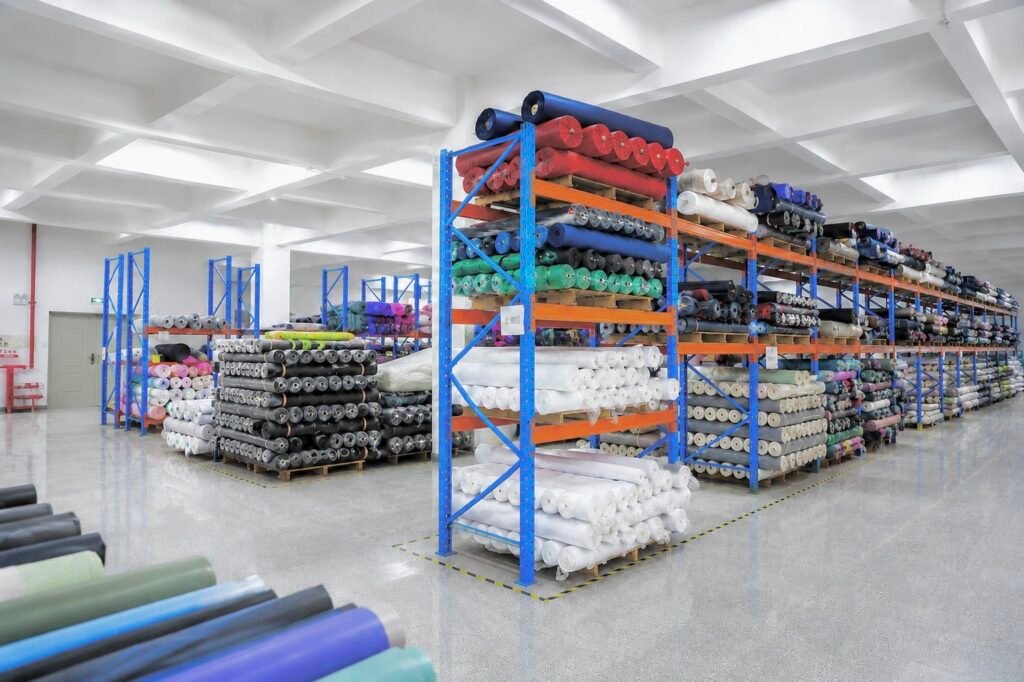
A fabric mill won’t dye a custom color or weave a specific denier of polyester below a certain yardage—often 300 to 1,000 meters, depending on the fabric type. This is a well-documented constraint in textile manufacturing: industry research on small-lot dyeing confirms that dye batch economics have historically pushed mills toward larger production runs per color, which is why custom colors carry a real cost and minimum threshold even at specialty mills. An electroplating workshop won’t run a custom hardware finish, like a matte gunmetal or brushed nickel, for a batch of a few hundred zipper pulls; the setup cost of mixing the chemical bath and calibrating the plating line only makes sense at volume. Even something as simple as custom-colored webbing for shoulder straps typically requires a minimum dye lot.
This is the root of almost every MOQ number you’ll see quoted. When a factory tells you their MOQ is 500 units, in most cases they’re not making that number up arbitrarily—they’re passing along the minimum imposed by their upstream material suppliers. A factory that doesn’t control its own material production has no choice but to inherit these constraints and pass them on to you.
This is also exactly why “flexible MOQ” is either a real structural advantage or an empty marketing phrase, depending entirely on whether the factory has any control over that upstream layer.
What “Flexible MOQ” Actually Means (and What It Doesn’t)
Here’s where most buyers get misled—not through outright dishonesty, but through vague wording that lets a supplier technically tell the truth while still setting an unrealistic expectation.
What suppliers usually mean when they say “flexible MOQ”:
In many cases, “flexible” applies only to the logo application step—meaning you can order 50 or 100 units of a factory’s existing stock design, with your logo screen-printed, embroidered, or heat-transferred onto it. This is genuinely low-MOQ, but it’s not really customization. The bag itself—fabric, color, hardware, structure—is unchanged from the factory’s catalog.
What buyers usually assume it means:
Most buyers reaching out about “flexible MOQ” are picturing something different: a backpack built to their own specifications—their chosen fabric color, their hardware finish, maybe a modified pocket layout—at a smaller order size. This is a fundamentally different request, because it touches the upstream material constraints described above.
This mismatch is where negotiations break down. A buyer sees “flexible MOQ, from 50 units” on a supplier’s website, sends over a spec sheet requesting a custom navy-and-tan colorway with matte black hardware, and receives a quote requiring 800 units minimum—with no explanation of why the number jumped so dramatically from what was advertised.
The honest answer is that both numbers were technically true. The supplier just never clarified which kind of “flexible” they meant.
Realistic MOQ Ranges by Customization Level
To set realistic expectations, here’s how MOQ typically scales with the depth of customization, based on standard industry constraints:
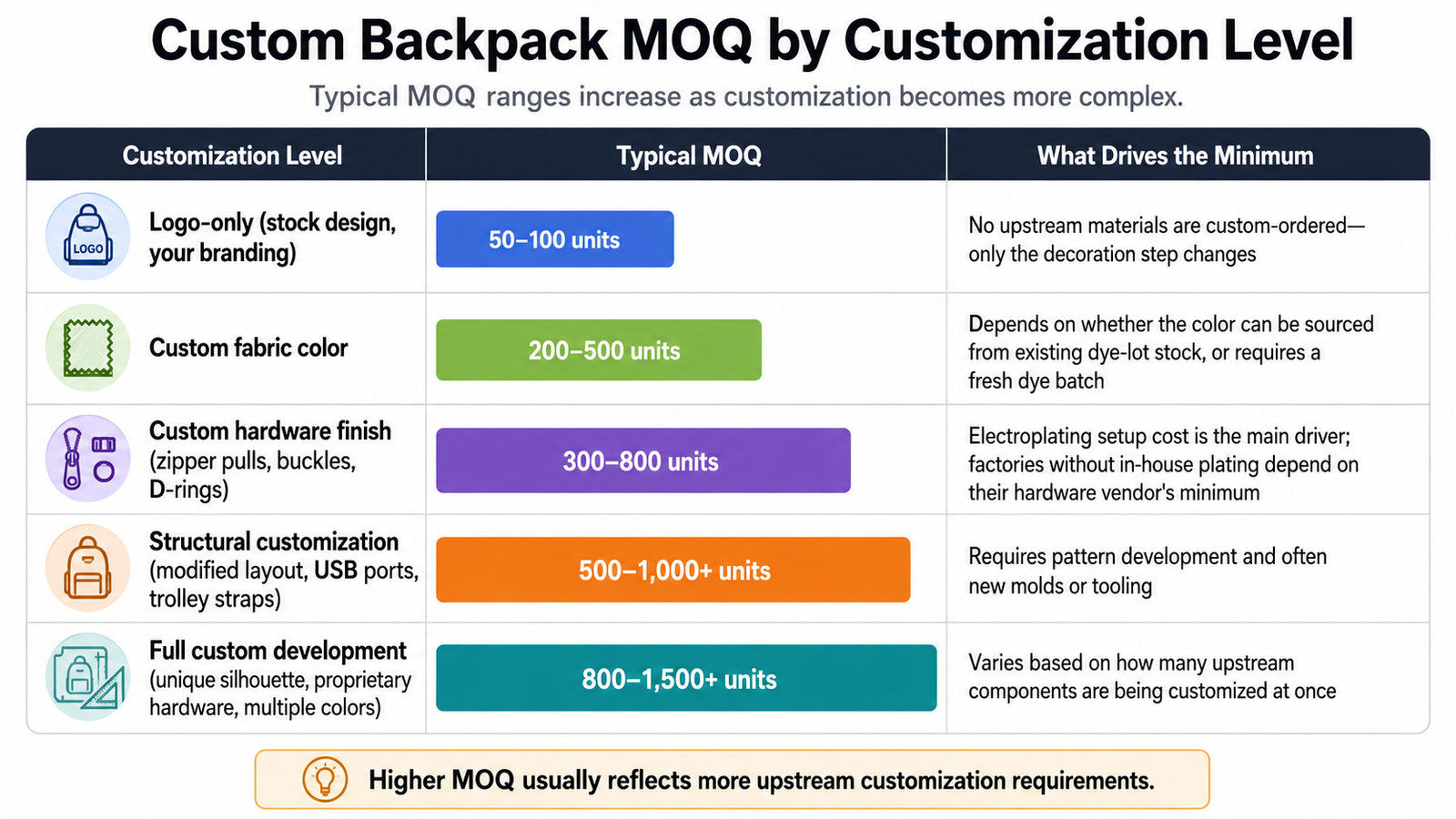
These ranges aren’t fixed rules—they shift depending on a factory’s specific supply chain setup—but they give you a realistic baseline to sanity-check any quote you receive.
A Common Scenario: When “Low MOQ” Quietly Becomes High MOQ
Here’s a scenario that plays out often enough to be worth walking through in detail, even without attaching it to a specific client.
A mid-sized corporate gifting company wants 600 custom laptop backpacks for a client event—not a huge order, but not tiny either. They reach out to a supplier advertising “flexible MOQ from 100 units” and submit a fairly modest spec: their brand’s signature teal color, plus a matte black zipper pull to match their logo’s metal accent.
The quote comes back requiring 1,200 units minimum, with a note that “custom color and hardware require higher MOQ.” The buyer is confused—600 units seemed well within a “flexible” range—and starts to suspect the supplier is simply trying to upsell them.
In most cases, that’s not actually what’s happening. What’s happening is that the supplier doesn’t operate its own dye house or electroplating line, so both the teal fabric and the matte black hardware need to be special-ordered from two separate third-party vendors—each with its own MOQ. The factory isn’t padding the number; it’s stacking two upstream minimums on top of each other and passing the total through.
This is precisely the scenario where a factory with in-house material production behaves differently—not because it’s more generous, but because it isn’t bound by someone else’s minimum in the first place.
How In-House Production Makes True Flexible MOQ Possible
This is the structural difference that separates a genuinely flexible manufacturer from one that’s simply repeating a marketing phrase.
When a factory owns its own fabric dyeing and hardware electroplating capability, it isn’t waiting on an external vendor’s minimum batch size—it’s running its own production schedule, and it can allocate smaller custom runs internally without the setup costs of coordinating with (and meeting the minimums of) two or three separate outside suppliers.
At Quanzhou Nice Bags, this is exactly how our in-house material factory changes the math for buyers in that 500–1,000 unit range—too large for a small workshop to handle economically, too small for factories dependent on outsourced materials to quote competitively. Because we control both fabric coloring and hardware finishing under one roof, we can combine a custom colorway and a custom hardware finish into a single internal production run, rather than stacking two external MOQs on top of each other.
This doesn’t mean every custom request can be fulfilled at 100 units—physics and chemistry still apply to dye batches and plating baths. But it does mean the ceiling is meaningfully lower, and more importantly, it means we can tell you why a specific MOQ applies to your specific spec, rather than quoting a generic number and hoping it doesn’t get questioned. (You can browse examples of the fabric colors, hardware finishes, and structural options we regularly produce in our Business Backpacks collection.)
Questions to Ask Before You Trust a “Low MOQ” Claim
Before taking any supplier’s “flexible MOQ” claim at face value, these questions will quickly reveal whether you’re dealing with genuine flexibility or a marketing phrase:
1. “Does this MOQ apply to logo-only orders, or to full customization?” This single question exposes the most common bait-and-switch in MOQ marketing.
2. “If I customize fabric color and hardware finish, does the MOQ change—and by how much?” A supplier who can answer this precisely, with real numbers, likely understands their own supply chain. A vague answer is a warning sign.
3. “Do you dye fabric and finish hardware in-house, or through third-party vendors?” This tells you whether the factory controls the variables that actually drive MOQ, or is simply passing along someone else’s constraints.
4. “Can you combine my color and hardware customization into a single production run?” Factories with integrated supply chains can often say yes. Factories without one usually can’t, because they’re coordinating separate external orders.
5. “What’s the MOQ difference between a standard color from your existing palette versus a brand-new custom color?” This reveals whether the factory has an existing library of pre-dyed options that could meet your needs at a lower minimum than a fully custom color would require.
MOQ is only one piece of vetting a supplier—for a broader checklist covering quality control, certifications, and production capability, see our guide on how to evaluate a reliable bag manufacturer. MOQ and price are two separate questions that often get confused — for a full breakdown of what actually drives the quote itself, see our guide on custom business backpack cost.
Three Ways to Bring MOQ Down Without Compromising Your Design
If a quoted MOQ comes in higher than your target order size, that doesn’t automatically mean the project is dead. There are a few practical levers that can bring the number down—some more effective than others, depending on what’s driving the minimum in the first place.
1. Choose from an existing color or material library instead of a fully custom option.
Many factories maintain a stock library of pre-dyed fabric colors and pre-finished hardware tones built up from previous production runs. If your target color is close enough to an existing option—rather than a completely new, never-before-run shade—you may be able to skip the custom dye batch entirely, which is often the single biggest MOQ driver. This is worth asking about explicitly, since suppliers don’t always volunteer it upfront.
2. Consolidate customization into fewer variables.
Every additional customized element—color, hardware finish, structural change—can introduce its own upstream minimum. A design with one custom color and stock hardware will almost always have a lower MOQ than the same design with a custom color and custom hardware and a modified pocket structure. If budget or volume is tight, it’s worth identifying which customizations matter most to your brand and which are negotiable.
3. Ask whether your order can be combined with a future production run.
Some factories are willing to hold a custom color or hardware finish in their system and combine your order with a similar request from another client’s upcoming run—effectively splitting a single dye batch or plating run across two smaller orders. This isn’t always available, and it depends on timing and confidentiality considerations, but it’s a legitimate question to raise, particularly with factories that run frequent production cycles.
None of these approaches guarantee a dramatically lower MOQ, and a supplier who promises they will should be treated with the same skepticism as one who throws out a vague “flexible MOQ” claim in the first place. But understanding these levers puts you in a much stronger position during quote negotiations—because you’re no longer just accepting a number, you’re able to ask why that number is what it is, and where there’s genuine room to move.
Conclusion
“Flexible MOQ” isn’t a false promise—but it’s also not a single, fixed number you can rely on across every supplier. The real answer to “how low can your MOQ go” always depends on exactly what’s being customized, and whether your supplier controls the upstream materials driving that number or is simply relaying someone else’s constraints.
For buyers in the 500–1,000 unit range—too large for a boutique workshop, too small to command factory-direct pricing from mega-manufacturers—finding a supplier with genuine in-house material production is often the difference between a project that’s financially viable and one that quietly balloons past budget once real customization enters the conversation.
Not sure whether your project fits a realistic MOQ range? Send your spec to our team for a free feasibility review—we’ll tell you exactly which parts of your design affect MOQ, and where there’s room to work within your target volume. Or browse our Business Backpacks collection for a starting point on materials, hardware, and structural options.
Frequently Asked Questions
What does “flexible MOQ” mean for custom backpacks?
It usually means low minimums (50–100 units) for logo-only orders on a factory’s existing stock design. Full customization—custom fabric colors, hardware finishes, or structural changes—typically requires a much higher MOQ, often 300–1,000+ units, because those elements depend on upstream material minimums.
Why do backpack manufacturers have different MOQs for different customizations?
Because MOQ is usually driven by upstream suppliers, not the bag factory itself. Fabric mills won’t dye a custom color below a certain yardage, and hardware electroplating workshops won’t run a custom finish below a certain batch size. Each additional customization can introduce its own minimum.
Can I get a custom color backpack with a low MOQ?
Sometimes, if the color is close to an existing option in the factory’s dye-lot library. A completely new, never-before-run color will almost always require a higher minimum, since it triggers a fresh dye batch.
How can I negotiate a lower MOQ with a backpack manufacturer?
Three effective approaches: choose from an existing color or material library instead of a brand-new custom color, reduce the number of customized elements in your design, or ask whether your order can be combined with another client’s upcoming production run.
Why do factories with in-house material production offer lower MOQs?
Because they control fabric dyeing and hardware finishing internally, rather than depending on third-party mills and plating vendors with their own separate minimums. This lets them combine multiple customizations into a single internal production run instead of stacking several external MOQs.