
Quick answer: A good custom dry bag order comes down to four decisions: fabric and seam construction (this determines your real waterproof rating, not the marketing copy), roll-top capacity (a bag’s rated liters shrink once you roll it closed), matching capacity to how the bag will actually be used, and MOQ (most factories split pricing between a low-MOQ logo-only tier and a higher-MOQ full-custom tier). Get these four right and the rest of the sourcing process is straightforward — the questions worth asking any supplier are largely the same ones covered in our guide on evaluating a reliable bag manufacturer, with the seam-construction question layered on top for this category specifically.
Why “Waterproof” Doesn’t Mean the Same Thing on Every Custom Dry Bag
Almost every dry bag listing says “waterproof.” Almost none of them say how the seams are made — and that’s the detail that actually determines whether the bag holds up.
A dry bag is waterproof because of two things working together: the fabric itself (which is coated or laminated to be non-porous) and the seams (where two pieces of that fabric are joined). The fabric is rarely the weak point. The seams are.
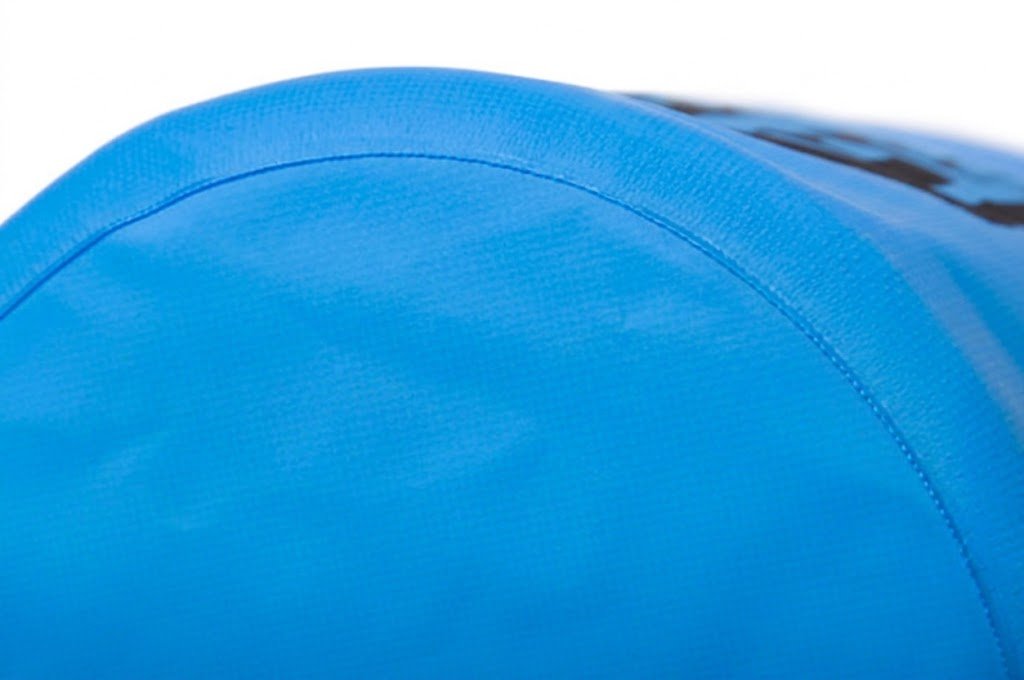
Stitched construction sews the fabric panels together with a needle and thread, then usually seals the seam with tape or a waterproof coating over the stitch line. This is the more common, lower-cost method, and it holds up well for everyday splash and rain exposure — the kind of moisture most dry bags actually see. The tradeoff is that every needle pass creates a tiny perforation in the fabric, and the seam tape that covers it can lift over time with heavy flexing, which is why stitched construction is best matched to general outdoor use rather than a stated numeric waterproof rating.
Radio-frequency (RF) welding, also called high-frequency welding, skips the needle entirely. Instead, it uses high-frequency electromagnetic energy to melt the coated fabric layers together into one continuous, fused seam — there’s no needle hole to begin with (Forsström’s overview of RF welding explains the process in more technical detail). This is the construction that can be tested and rated in the IPX6-IPX7 range, and it’s what you want for anything going near full submersion rather than just weather exposure — it costs more to produce because the equipment and cycle time are more involved.
Neither method is “wrong” — the right one depends on what the bag needs to survive. A dry bag for a weekend paddling trip doesn’t need the same seam integrity as one going on a dive boat.
The Roll-Top Isn’t Just a Waterproof Seal — It’s an Adjustable, Compressible Design
Most buying guides describe a roll-top closure as a waterproofing mechanism and stop there. That’s only half of what it does.
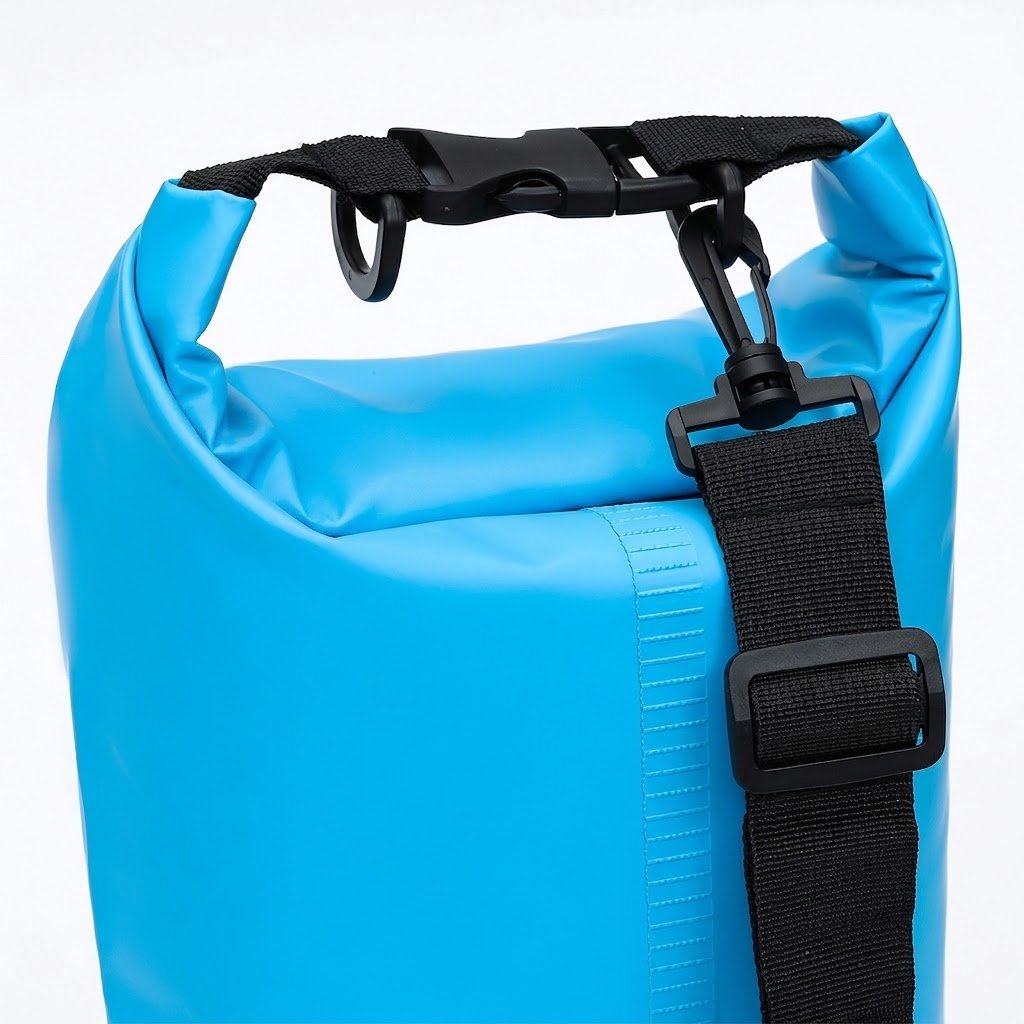
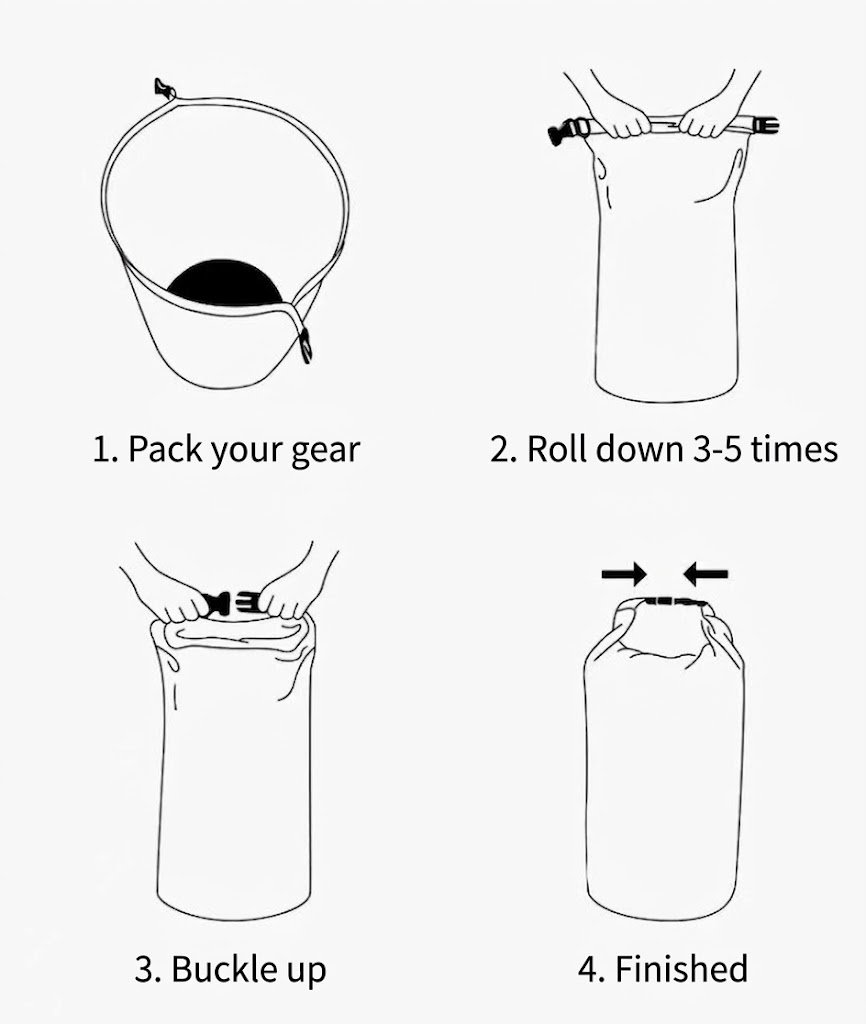
Rolling the top down three to four times before clipping it shut is what makes the closure waterproof — folding the coated fabric over itself that many times creates a seal even without a zipper or valve. But that same rolling mechanism is also how the bag adjusts its own size: roll it down further when it’s half-full, and you’re not just sealing it, you’re compressing it and pushing out excess air, which shrinks the bag’s overall bulk for packing. Roll it down the minimum number of times when it’s full, and you get the bag’s full rated capacity.
This cuts both ways, and buyers should know the tradeoff. The rolling needed to seal the bag typically uses up roughly 15-20% of its rated volume — so a bag rated at 20L realistically carries closer to 16-17L once it’s rolled and clipped for a proper seal. That’s not a flaw in the design; it’s the mechanism working as intended. But it does mean a buyer packing to a bag’s exact rated capacity on paper will come up short in practice, which is worth knowing before you spec a capacity for a promotional order or gift program where “how much actually fits” matters.
Matching Capacity to How the Bag Will Actually Be Used
Dry bags aren’t a one-size product, and the right capacity depends heavily on whether it needs to be carried in a hand, over one shoulder, or on the back.
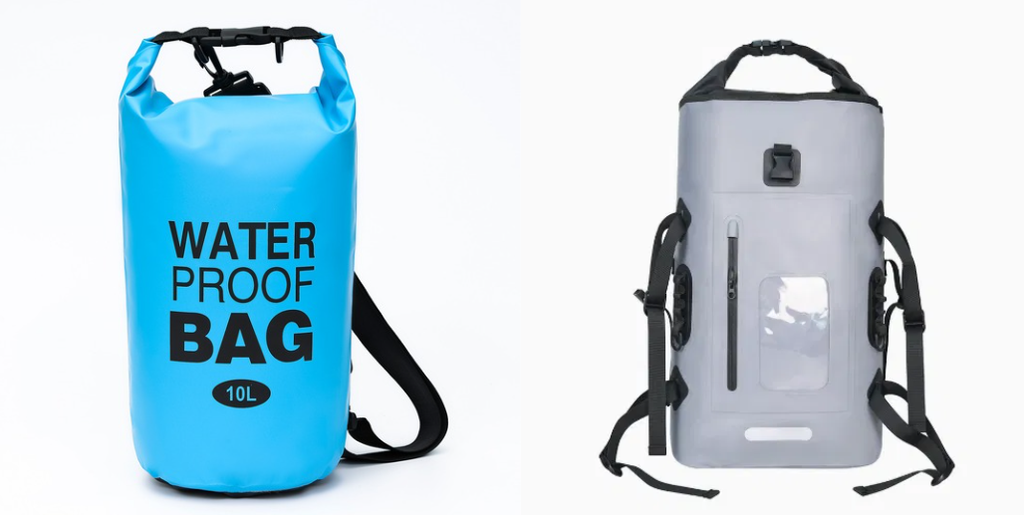
Single-strap / hand-carry sizes (2L, 3L, 5L, 10L) work best for phones, wallets, small electronics, or a change of clothes — the kind of item someone wants sealed and accessible, not stowed for a full day. These sizes are common in beach, boating, and water-sport promotional gifting because they’re cheap to produce and easy to brand visibly.
Dual-strap backpack sizes (15L, 20L, 25L, 30L) are built for longer exposure — kayaking, rafting, motorcycle touring, hiking near water — where the bag rides on the back for hours and needs to carry a full day’s gear rather than a handful of items. These sizes typically add reinforced strap mounting points and sometimes a padded back panel, which is part of why they cost more per unit than the jump in fabric alone would suggest.
Nice Bags produces both ranges as standard, and capacity beyond these is fully customizable to a buyer’s spec.
What Actually Drives the Price (It’s Not Just Liters)
The most common mistake in dry bag sourcing is assuming price scales cleanly with size. It doesn’t — construction and hardware move the number more than capacity does.
As a rough sense of range, tied to both size and construction so the numbers aren’t misleading on their own: a small 2-5L single-strap bag with basic stitched construction and a plastic buckle can land at roughly $1.50-2 per unit. A fully-loaded 30-35L backpack-style bag with welded seams, padded straps, reflective trim, and extra hardware can climb toward $15-17. These two numbers describe different bags at opposite ends of the range, not a low and high quote for the same size — a 30L bag built to the same basic stitched spec as the small bag will cost more than $2 simply because it uses more material and larger hardware, even before any premium features are added. Construction and hardware move the price the most within a given size, but size still sets the floor.
The practical takeaway for buyers: treat any per-unit number as a starting reference, not a quote — ask what specific construction and hardware it assumes before comparing prices across suppliers. Two quotes for “a 20L dry bag” can differ substantially once you account for stitched-vs-welded seams and how many extras are bundled in. Send over your target capacity and feature list and we’ll give you an exact number for your specific spec.
Logo application (screen print or heat transfer on the panel) is typically a small flat add per unit rather than a percentage of the base price.
MOQ: What’s Realistic at Each Order Size
Dry bag MOQs generally split into two tiers, the same pattern seen across most of Nice Bags’ product categories:
- Logo-only on an existing stock design: 50 units minimum. This covers adding a printed or heat-transferred logo to a bag Nice Bags already produces in standard colors and capacities — fastest turnaround, lowest commitment.
- Full custom development (new color, custom hardware, structural changes, or a capacity outside the standard range): 500 units minimum, consistent with the upstream material minimums that drive MOQ across custom bag manufacturing generally — the same logic covered in our flexible MOQ guide for business backpacks applies here: a factory’s MOQ is usually inherited from fabric and hardware suppliers upstream, not set arbitrarily.
Frequently Asked Questions
What do IPX ratings actually mean for a dry bag? IPX ratings measure resistance to water ingress under standardized test conditions, from splash and spray resistance up to full submersion (see the IP Code standard for the full ratings scale). Not every dry bag on the market is tested to a specific number — a lot of “everyday” bags are built and marketed around general splash/rain resistance without a stated IPX figure, and that’s normal for products that were never intended for submersion in the first place. If your program needs a specific tested rating, RF-welded construction is what makes IPX6-IPX7 testing realistic.
Should I choose stitched or RF-welded seam construction? It depends on how the bag will actually be used. Stitched construction is the right call for general outdoor use — rain, splash, being set down on wet ground — and costs less, though it isn’t the construction to reach for if you need a specific tested IPX number. RF-welded seams cost more but eliminate the needle-hole seam entirely and are what’s needed for a bag that has to handle full submersion, tested to IPX6-IPX7, rather than just weather exposure.
What’s the minimum order for a custom dry bag with our logo? 50 units for a logo application on an existing stock design and capacity. Full custom development (new colors, hardware, or structure) starts at 500 units.
Does a bigger dry bag mean a proportionally higher price? No — construction method and hardware typically move the price more than capacity alone. A welded-seam bag or one with added features like a waterproof zipper, padded straps, or reflective trim can cost significantly more than a larger bag built to a simpler spec.
Browse our waterproof dry bag range for a starting point on capacities and styles, or get in touch with your target spec for an exact quote.